
Open PDF in Browser: Carolina Núñez, Lucy Williams, David Wingate, Aerin Christensen, & Anna Mae Walker,* “Women’s Language” in Supreme Court Oral Arguments
“[A] girl is damned if she does, damned if she doesn’t. If she refuses to talk like a lady, she is ridiculed and subjected to criticism as unfeminine; if she does learn, she is ridiculed as unable to think clearly, unable to take part in a serious discussion: in some sense, as less than fully human.”
— Robin Lakoff[1]
In 1973, sociolinguist Robin Lakoff famously argued that female speakers use “women’s language”—a distinct set of linguistic patterns that signal tentativeness, diffidence, and powerlessness. In this Article, we test that hypothesis by identifying and analyzing gendered language patterns during Supreme Court oral arguments. We lexically analyze a corpus of more than six thousand oral arguments to identify four features of “women’s language”: hedges, super polite forms, intensifiers, and hesitation forms. We find striking evidence to support Lakoff’s hypothesis: The women in our dataset do, in fact, hedge more, hesitate more, intensify more, and use more polite forms than their male counterparts.
Our results have important implications for the study of gender, language, and the law. Since the 1970s, scholars have debated whether “women’s language” is an actual, measurable phenomenon. Our study—the first to examine “women’s language” in the Supreme Court context—suggests that it is. Our study also prompts questions about how “women’s language” affects law and the women who practice it. It is possible that “women’s language” facilitates communication, or that it is a stylistic choice that has no effect on women’s arguments, ideas, or identities. If that is true, then the patterns we observe are curious, but nothing more. But as Lakoff insisted, it is also possible that “women’s language” reflects women’s inequality and maintains women in a subordinate status. If that is so, then it is troubling to see such clear evidence of “women’s language” at the Supreme Court.
The Article proceeds in four parts. In Part I, we introduce “women’s language” and describe previous research that has explored its nuances. In Part II, we discuss our dataset and methods and describe our analysis. In Part III, we present and discuss our results. In Part IV, we explore the substantive and normative implications of our research and identify avenues for future study.
Introduction
In the 1872 case Bradwell v. Illinois, the Supreme Court held that states could deny women the right to practice law.[2] Justice Bradley’s concurring opinion explained that the Court’s decision was proper because “[t]he natural and proper timidity and delicacy which belongs to the female sex evidently unfits it for many of the occupations of civil life.”[3] In the 150 years since that decision, American women have proved the Court and Justice Bradley wrong.[4] Since the first woman was admitted to the Supreme Court Bar in 1879, the number of women in the legal profession has exploded. In 2023, more than half of America’s law students were women, compared to only 9 percent in 1970.[5] More than 50 percent of law firm associates are now women, compared to roughly 38 percent in 1991.[6] And whereas there were no female Article III judges for the first 138 years of American history, women now make up approximately one-third of the federal judiciary.[7] Men “still dominate the upper echelons of the legal profession,”[8] but women are now better represented in the legal field than ever before.[9]
Not surprisingly, the increasing number of women in law has prompted new research about women and law. In recent years, legal scholars have devoted new attention to reproductive rights,[10] domestic violence,[11] and other substantive legal issues that uniquely affect women’s bodies.[12] They have studied the social, political, and professional barriers that prevent women from obtaining prominent or powerful legal positions.[13] They have considered how gender affects female judges’ approach to legal issues.[14] And they have studied how female lawyers are treated in classrooms, law firms, and courts.[15]
Notably absent from these studies is any research about how women in the legal profession speak. This dearth is surprising. In nearly every other field—including business,[16] healthcare,[17] education,[18] sociology,[19] and linguistics[20]—scholars have spent considerable energy exploring how women use language to construct their social and professional identities.[21] In law, though, we know more about when and why women don’t talk[22] than about what they say when they do.
This Article begins to fill that gap by offering an analysis of the language women use during oral argument at the United States Supreme Court. Using a variety of statistical methods, we analyze a corpus of over 1.5 million conversational turns from 6,063 oral argument transcripts to identify instances of what linguist Robin Lakoff termed “women’s language”—a distinct set of linguistic patterns and tropes that convey tentativeness, insecurity, and powerlessness.[23] We focus, in particular, on four features of that discourse: hedges (e.g., “probably,” “generally,” “supposedly”), super polite forms (e.g., “thank you,” “respectfully”), intensifiers (e.g., “very,” “clearly”), and hesitation forms (e.g., pauses, stutters, “I mean”). Our analysis reveals that there are clear differences between the ways men and women speak during oral argument. Women use all four “women’s language” tropes more than their male counterparts do. Given that finding, it is not surprising that our data also show that “women’s language” has increased over time during Court arguments. After all, women are a larger share of the speakers during oral argument today than they were fifty years ago.[24] But our data suggest that something more interesting is going on. Male advocates are using more “women’s language” today than they were fifty years ago, and male Justices use more “women’s language” than male advocates do. These findings do not change the strongest dynamic we observe—that women use more “women’s language” across the board—but they do raise new questions and opportunities for discussion.
Our findings have important implications for scholarship on women, language, and the law. First, and most obviously, our results offer new insights for ongoing debates about “women’s language.” Countless scholars in linguistics and other fields have tried to determine whether Lakoff’s “women’s language” is an actual phenomenon, but previous research has reached conflicting results.[25] Our study does not resolve those inconsistencies, but it does provide new evidence for the proposition that women speak differently than men. Our study also uses advanced lexical analysis with regular expressions, which are more powerful and precise than the manual techniques “women’s language” researchers have used in the past.[26] Our analysis thus illustrates how researchers in law, linguistics, and other fields might use such methods to study unresolved questions about gender and language.
More importantly, our results prompt questions about how “women’s language” affects the law and the women who practice it. When Lakoff first conceptualized “women’s language,” she suggested that the speech patterns she described both reflect and reinforce women’s subordinate status in society. Specifically, Lakoff argued that women are taught from a young age to speak in a certain way, and when they comply, others interpret their language as “proof” of women’s subordinate role.[27] In recent years, though, some researchers have rejected Lakoff’s normative assessment and have instead argued that “women’s language” serves important communicative and persuasive functions.[28] If this latter view is correct, then the “women’s language” we observe might be a useful model for lawyers of any gender who are seeking to improve their craft. Our finding that male advocates have increasingly adopted “women’s language” is consistent with this theory. But if “women’s language” is a source and symptom of subordination, as Lakoff suggested, our findings raise some troubling possibilities. The “women’s language” we observe might, for instance, indicate that women are or feel inferior even when they are highly trained, highly educated, and operating at the pinnacle of the legal field. It might also shore up existing gender inequalities by making “women’s language” public, visible, and prominent.
These questions of gender, language, power, and law are pressing and pertinent. In recent years, the Supreme Court has dealt major blows to women’s reproductive rights.[29] Several states have enacted laws that prohibit required usage or discussion of preferred pronouns.[30] Other states have passed legislation banning transgender people from seeking gender-affirming care or from using bathrooms consistent with their gender identities.[31] And most recently, the Trump administration has declared its commitment to “defend women’s rights . . . by using clear and accurate language and policies that recognize women are biologically female.”[32] With these and other issues of gender, language, and law at the forefront of American politics, Lakoff’s hypothesis remains as relevant and troubling as it was fifty years ago. It also warrants further study and investigation because if language does, in fact, reflect and perpetuate gender and power inequities, that discovery could have important implications for how judges, lawyers, and legal academics think through and talk about contemporary legal issues.
This Article proceeds in four parts. In Part I, we introduce “women’s language” and describe previous research that has explored its nuances. In Part II, we discuss our dataset and methods and describe our analysis. In Part III, we present and discuss our results. In Part IV, we discuss the substantive and normative implications of our findings and identify avenues for future study.
Robin Lakoff and “Women’s Language”
Gender and language research is an interdisciplinary field that analyzes “the linguistic resources individuals draw on to present themselves as gendered beings” and “the discursive construction of gender and its many components through words and images.”[33] The field includes researchers from many academic disciplines, including linguistics, communications, education, business, and medicine.[34] And it encompasses a variety of methods, ranging from conversation analysis, stylistics, and discourse analysis to ethnography and corpus linguistics.[35]
One of the first and most influential scholars in gender and language research was the linguist Robin Lakoff.[36] In a 1973 article titled “Language and Women’s Place,” Lakoff famously argued that women speak differently than men.[37] Using “introspective methods”—namely, her own observations of women’s speech—Lakoff proposed that women use a distinctive “women’s language” made up of particular lexical units, syntactical rules, and intonational patterns. Specifically, Lakoff argued that women use precise color terms (e.g., “mauve” instead of “purple”),[38] avoid strong expletives,[39] and employ empty adjectives like “lovely” and “sweet.”[40] They convert declarative sentences into questions by using rising intonation.[41] Women also use tag questions (e.g., “Right?” or “Isn’t that true?”),[42] hedges (e.g., “somewhat,” “generally”),[43] intensifiers (e.g., “very,” “really”),[44] hypercorrect grammar,[45] and super polite language (e.g., “please,” “excuse me”).[46]
According to Lakoff, “women’s language” often comes across as hesitant, tentative, or trivial. For example, tag questions “give the impression [that a speaker is not] really sure of himself, . . . looking to the addressee for confirmation, . . . [or has] no views of his own.”[47] Hedges communicate diffidence and “convey the sense that the speaker is uncertain about what he (or she) is saying.”[48] Polite, profanity-free language limits a speaker’s ability to express strong emotions.[49] And precise color terms (“mauve” instead of “purple”) indicate awareness of and responsibility for trivial descriptions.[50] Taken together, the tropes of “women’s language” thus “submerge[] a woman’s personal identity by denying her the means of expressing herself strongly . . . and encouraging expressions that suggest triviality in subject matter and uncertainty about it.”[51] “The ultimate effect,” Lakoff concluded, “is that women are systematically denied access to power[] on the grounds that they are not capable of holding it as demonstrated by their linguistic behavior.”[52]
Since the 1970s, dozens of scholars have tested, challenged, extended, and complicated Lakoff’s hypothesis.[53] Some have questioned whether the linguistic patterns Lakoff observed stem from gender or from something else—social status,[54] age,[55] culture,[56] relational factors,[57] personality factors,[58] self-conception about sex roles, and more.[59] Others have analyzed the effects of gendered language patterns by considering whether so-called “women’s language” affects a speaker’s persuasiveness,[60] attractiveness,[61] or ability to exert social influence.[62] A few have questioned Lakoff’s description and identification of “women’s language” tropes, noting that linguistic forms like hedging and tag questions can “serve different ends across different sociolinguistic contexts.”[63] Some have engaged with the normative implications of Lakoff’s hypothesis, arguing that gendered language patterns—if they exist—reflect differences but “do not involve deficiencies.”[64] And many have used empirical methods (as opposed to Lakoff’s “introspective” technique[65]) to test the hypothesis that men and women speak differently.[66]
Scholars have likewise refined, applied, and extended Lakoff’s ideas into the legal field. For example, in one of the earliest and most influential studies to test Lakoff’s hypothesis, William O’Barr and Bowman K. Atkins used ethnographic methods to analyze “women’s language” in North Carolina trial courts.[67] They discovered that some women used “women’s language” more than others and that men occasionally used it, too.[68] They also observed that the speakers who used “women’s language” most frequently tended to occupy a lower social status.[69] The authors thus determined that “so-called ‘women’s language’ is neither characteristic of all women nor limited to only women.”[70] Rather, “the variation in [‘women’s language’] features may be related more to social powerlessness than to sex.”[71]
Legal scholars have also considered the effects of “women’s language” in various legal contexts. They have used surveys and experiments to determine whether “women’s language” (or “powerless language,” to use O’Barr and Atkins’s terminology) affects perceptions of credibility or blame in courtroom proceedings.[72] They have studied the effects of “women’s language” in different types of legal writing, including wills,[73] appellate opinions,[74] and briefs.[75] They have considered how “women’s language”—if it exists—affects speakers’ ability to access procedural justice or exercise rights that must be invoked verbally, like the Fifth Amendment rights to counsel and silence.[76] And they have generally examined how “women’s language” affects courtroom and client interactions.[77]
Surprisingly and disappointingly, this vast literature has yielded few clear insights about “women’s language.” Scholars disagree about how to identify and measure the tropes of “women’s language” in the first instance.[78] They also disagree about the normative significance of gendered language patterns. Though some maintain that “women’s language” is a marker of tentativeness or submission,[79] others suggest that the tropes of “women’s language” might actually be powerful linguistic techniques that women use to express interpersonal solidarity,[80] articulate care or concern,[81] or fulfill other important functions.[82] Perhaps most significantly, academics disagree about whether the phenomenon of “women’s language” actually exists: Though many studies suggest that women do, in fact, use the linguistic features Lakoff identified,[83] others have found that men are more likely to use those features,[84] or that there is no relationship at all between gender and language patterns.[85] In short, notwithstanding fifty years of scholarly pursuit, “[i]t is now apparent that, if they do exist, gender differences in hedging [and in language overall] are subtle and subject to marked variation across speakers and contexts of use.”[86]
In what follows, we revisit Lakoff’s simplest, original hypothesis—namely, that women speak differently than men. More specifically, we use lexical analysis to identify and analyze the tropes of “women’s language” in a new context: oral arguments at the United States Supreme Court.[87] Our study, which we describe in Part II below, is the first to investigate “women’s language” in the Supreme Court context.[88] It is also the first to use statistical lexical analysis to analyze “women’s language” in the law. Our work thus offers new and novel insights about whether and how Justices and advocates at the nation’s highest Court use “women’s language.” It also illustrates how future legal researchers might use similar analytical techniques to study more nuanced questions about language, gender, and power.
Measuring “Women’s Language” In Supreme Court Oral Arguments
Data
Our study relies on a corpus of Supreme Court oral argument transcripts from 1955 to 2024. We created this corpus using transcripts from Oyez.org, a multimedia archive that provides transcripts, synchronized and searchable audio, case summaries, and full-text opinions for nearly every Supreme Court case. Though similar transcripts are available on the Supreme Court’s website, we used Oyez because it covers more years of Supreme Court argument: The Supreme Court’s official archive begins in 1968, whereas Oyez begins in 1955. The Oyez transcripts also identify the speakers who participated in each oral argument—something that official Supreme Court transcripts did not do until 2004.[89]
The Oyez transcripts from 1980 to the present are based on the same official Court transcripts that are available on the Supreme Court’s website.[90] For terms prior to 1980, Oyez used outsourced labor to generate the transcripts from audio recordings of oral argument.[91] In our communications with Oyez, a representative noted that poor-quality source audio occasionally made it difficult for the Oyez team to accurately transcribe the arguments and speaker identities, “though the extent of the inaccuracies is challenging to measure.”[92] Notwithstanding these shortcomings, the Supreme Court’s website lists Oyez alongside Westlaw, Lexis Advance, the National Archives, and ProQuest as a place where researchers can access oral argument transcripts.[93] We thus feel confident that the Oyez transcripts are an accurate and reliable source for our study.
Transcripts provided by Oyez are organized by docket number. Each case is then separated into conversational turns, or continuous segments of speech attributed to different speakers. Each turn is annotated with pointers to the relevant audio recording, and is attributed to a single speaker, along with some metadata about the speakers’ role (either as a Justice or as an advocate).
To preprocess the data, each conversational turn was annotated with year, docket number, current speaker, current speaker’s gender, previous speaker, previous speaker’s gender, and the “relative year” of service of the current speaker.
Oyez does not provide the gender of the speakers. To determine the gender of each of the speakers, we analyzed each name using the GPT-4o language model from OpenAI. GPT-4o, drawing on its training data (which includes publicly available data, proprietary data, audio, video, and code), coded each name with a gender.[94] Though the oral argument transcripts may have been part of GPT-4o’s training data, we did not provide those transcripts when we provided the speakers’ names, and we did not prompt GPT-4o to consider the transcripts when assigning gender. However, we did provide some context about the speaker in question, telling GPT-4o that it was someone who argued before the Supreme Court, with the date and title of the case. Finally, we allowed GPT-4o to respond with “unknown” as the gender; in those cases, manual human annotation was used to assign gender.[95]
In total, our corpus contains transcripts from 6,063 cases. It includes 66,102,723 words spoken across 1,512,720 conversational turns by 8,833 different oral argument speakers. Eighty‑nine percent of our corpus consist of turns spoken by men; 9 percent spoken by women, and 2 percent with an unknown gender.
Coding “Women’s Language”
Lakoff’s original essay identified at least twelve features of “women’s language.”[96] These include:
- Hedges (e.g., “It seems to me that . . . ,” “I’m not sure I agree . . . .”)
- Super polite forms (e.g., “If you don’t mind . . . ,” “Could you please . . . .”)
- Tag questions (e.g., “It’s nice here, isn’t it?”)
- Intensifiers, or “speaking in italics”[97] (placing emphatic stress on words like “very,” “super,” and “so”)
- Empty adjectives (e.g., “cute,” “lovely,” “divine”)
- Hypercorrect grammar and pronunciation
- Lack of humor
- Heavy use of direct quotes
- Precise color terms (e.g., “mauve” instead of “purple”)
- Rising intonation on declarative statements (e.g., “I don’t agree?”)
- Hesitation forms (e.g., “um” and repeated words)
- Avoidance of strong swear words
Of these twelve tropes, we analyze four: (1) hedges, (2) super polite forms, (3) intensifiers, and (4) hesitation forms. We selected these tropes because they routinely occur during oral arguments and are readily identifiable in written transcripts. We omitted the remaining eight tropes because they are either irrelevant or absent during oral argument or because they are difficult to identify using lexical methods. For example, four of the tropes we omitted—hypercorrect grammar, empty adjectives, precise color terms, and avoidance of strong swear words—are either absent or irrelevant during oral argument. Supreme Court arguments are formal and professional proceedings, so participants tend to avoid both profanity and frivolous words. All participants are highly educated and hyper prepared, so they generally use grammar that is precise and correct. And because oral arguments are often highly technical discussions of law, there are rarely reasons for participants to use color terms. We thus expected to see little variation in any of these “women’s language” features.
We also excluded tag questions and direct quotations, because both take on different meanings in oral argument than in ordinary speech. In day-to-day conversation, tag questions and direct quotes might indicate diffidence or insecurity.[98] In an appellate argument, though, parties routinely quote caselaw, statutes, and legal briefs to establish the authority of their positions. And while advocates rarely ask questions of the Justices, Justices always (if not exclusively) ask questions of the advocates, and they often do so using the tag-question form.[99] Analyses of tag questions and direct quotes are thus likely to yield skewed or misleading results. Because of this, we excluded both from our study.
Finally, we excluded tropes that are difficult to identify or analyze using lexical analysis. Humor is subjective, and laughter generally does not appear in oral argument transcripts. Intonation likewise is not detectable in written transcripts.
These exclusions limit our ability to draw conclusions about “women’s language” broadly. However, there are many existing studies that focus on just one or two “women’s language” tropes.[100] Our analysis thus offers more breadth than many prior analyses. Further, our study is the first to analyze “women’s language” in Supreme Court oral arguments. If it is narrow, it nonetheless provides novel insights about gendered language patterns in the nation’s highest Court.
In the remainder of this Section, we explain the technical decisions we used to identify hedges, super polite forms, intensifiers, and hesitation forms in Supreme Court oral argument. In the following Part III, we present our analysis.
Hedges
Hedges are words or phrases that “make language less definite”[101] and “convey the sense that the speaker is uncertain about what he (or she) is saying, or cannot vouch for the accuracy of the statement.”[102] Hedges also distance speakers from their assertions and make a speaker’s claims less susceptible to falsification because it is difficult to challenge a statement that a speaker has cabined from the outset.[103]
In 2012, Rachael Hinkle conducted a study of more than fifty hedges in judicial opinions.[104] Our study borrows from Hinkle’s list, but we use only those hedges that seem most likely to appear in oral argument. Additionally, we include hedges that appeared during our preliminary review of the oral argument transcripts. We include all possible tenses and variations of each word—for example, “approximate” and “approximately”; “seem,” “seems,” and “seemed,” and so on. In total, our analysis includes 107 hedges, which we list in the footnote below.[105]
Super polite Forms
Super polite forms are words or phrases a speaker uses to convey politeness and propriety.[106] According to Lakoff, women use super polite forms because “women are the repositories of tact and know the right things to say to other people.”[107] Further, women are expected to conform to societal rules—including rules about civility and politeness—and they suffer social consequences (more so than men) when they stray from those conventions.[108]
Any word or phrase that is traditionally used to convey formality or deference qualifies as a super polite form. Lakoff specifically identifies two: “please” and “thank you.”[109] But Lakoff also acknowledges that super polite forms may vary across contexts and cultures.[110]
For this study, we identified eleven polite forms that are particularly likely to appear in the context of oral argument: “thank you,” “thanks,” “I appreciate,” “please,” “excuse me,” “would like,” “have to,” “could,” “my friend,” “sorry,” and “respectfully.” We omitted the polite form “your honor,” because it is essentially required during oral argument: By convention, advocates always address Justices as either “Justice” or “your honor.” Further, only advocates use the term “your honor”; Justices never refer to themselves or others that way. Thus, the frequencies of “your honor” would be inevitably skewed toward advocates.
Intensifiers
Intensifiers—words like “clearly,” “obviously,” and “so”—“intensif[y] the meaning of the word or phrase that [they] modif[y].”[111] In her original article, Lakoff posited that intensifiers are signs of tentativeness and powerless because they allow speakers “a way of backing out of committing oneself strongly to an opinion.”[112] More recently, scholars have suggested that intensifiers convey insecurity because they “are used to cover up a lack of logical proof”[113]—that is, speakers turn to intensifiers when they have no other support for their claims.[114]
For this analysis, we focused on the same twelve intensifiers that Long and Christensen included in their 2008 study of intensifiers in appellate briefs: “very,” “obviously,” “clearly,” “patently,” “absolutely,” “really,” “plainly,” “undoubtedly,” “certainly,” “totally,” “simply,” and “wholly.”[115] We also coded for five of the intensifiers included in Bradac, Mulac, and Thompson’s 1995 study of intensifiers in small group problem-solving conversations: “completely,” “definitely,” “extremely,” “fully,” and “quite.”[116] We selected these intensifiers because they have previously been studied in the legal context, seem particularly likely to appear in Supreme Court oral arguments, or both. We excluded other intensifiers that are colloquial, slang, or vulgar and therefore less likely to be present in our dataset.[117]
Hesitation Forms
Hesitation forms are any language pattern that causes a disruption in the flow of speech.[118] These include pauses, self‑repetitions, stutters, filler words (e.g., “um,” “ah,” “eh”), and meaningless small words (e.g., “you know,” “oh,” “well,”
“let’s see”).[119] Like other tropes of “women’s language,” hesitation forms are thought to make speakers seem less confident and credible, regardless of the content of their speech.[120]
Our study analyzes one type of hesitation form: meaningless phrases.[121] We focus on meaningless phrases because oral argument transcripts are inconsistent in whether and how they record filler words like “um” and “eh.” They are also inconsistent in how they record pauses and self-repetitions. Sometimes these hesitation forms are transcribed as either “—” or “. . . ,” sometimes they are written out, and sometimes they are not transcribed at all.[122] Because of these inconsistencies and variations, we chose not to include self-repetitions, pauses, and filler words in our analysis.
To measure meaningless phrases, we selected nine words and phrases that other scholars have used in their research on hesitation forms. From O’Barr and Atkins’s 1980 study of trial transcripts, we included: “oh,” “well,” “let’s see,” “now,” and “so.”[123] And from Boonsuk, Ambele, and Buddharat’s 2019 study, we included: “I think,” “I mean,” “you know,” and “you see.”[124]
Methods
The tropes we have identified are defined by specific sets of words and phrases that can be easily identified in argument transcripts. This suggests a straightforward technical strategy: Instead of a semantic analysis of the meaning of arguments, we instead opt for an analysis of the specific words used by specific speakers. This is known as “lexical analysis”; a semantic analysis of our data is possible but is beyond the scope of this Article.[125]
Detecting tropes in transcripts is a straightforward programming task. We analyzed the transcript associated with each case by identifying each speaker’s conversation turns—that is, the continuous segment of text attributed to that speaker before another speaker begins or the transcript ends. We then searched the text of each turn for each trope word. We counted the number of occurrences of each trope word and attributed that count to the trope word’s corresponding category. Searching was accomplished using standard regular expressions (a basic pattern‑matching technique that allows us to account for variations on a base lemma), with some lightweight text preprocessing. This was all automated with a single analysis script to avoid any human-introduced error. Finally, the category counts were attributed to individual speakers via the metadata provided by Oyez.
However, not all Court participants speak for equal amounts of time—there are significant differences between the number of words spoken by different speakers, with some only contributing a few hundred words to an argument, while others may contribute thousands. To compensate for the variability in per-speaker word counts, we centered our analysis on the rate at which a given speaker uses women’s tropes. This rate was calculated by counting the number of trope words used by a speaker divided by the total number of words used by a speaker.
Any individual speaker (either Justice or advocate) may participate in multiple cases before the Court in any given year. Preliminary analysis (not included in this Article) suggested that the rate of trope usage changes over the course of an individual’s career. For both of these reasons, we opted to calculate trope rates by aggregating counts on a per-year basis.
Our data therefore consists of tuples of (year, speaker, gender, role, trope rate); any given speaker may appear multiple times in our dataset. The “role” data is provided by Oyez and indicates an individual’s role at the time the case was argued. Certain individuals (such as Ruth Bader Ginsburg) argued cases before the Court as an advocate before joining as a Justice, and therefore appear in our data multiple times with multiple different roles.
Results
In this Section, we catalogue and explore our results. We first provide a high-level visualization of our data’s overall quantity and distribution across time. We then compare “women’s language” usage by gender and role, in the aggregate and across time. Our analysis reveals five striking patterns.
First, our analysis shows that “women’s language” exists in Supreme Court oral arguments: On average, female speakers in our dataset hedge more, hesitate more, intensify more, and use more super polite forms than their male counterparts. Second, these usage patterns exist regardless of the speaker’s role: Female Justices use more “women’s language” than male Justices, and female advocates use more “women’s language” than male advocates. Third, we observe that “women’s language” usage has increased over time for men and women participating in oral arguments.
Our fourth finding is that Justices use “women’s language” more than advocates do: Male Justices and female Justices use “women’s language” more than male advocates and female advocates, respectively. Fifth, and perhaps most interestingly, male Justices’ trends in their “women’s language” usage parallel female Justices’ usage trends. That is, when “women’s language” increases among the female Justices, the same occurs in the male Justices’ rate of usage.
In the remainder of this Section, we elaborate on each of these findings in the course of discussing (1) our dataset as a whole, (2) speaker gender and corresponding rates of “women’s language,” (3) speaker role and corresponding “women’s language” rates, and (4) historical trends in Justices’ and advocates’ rates of “women’s language.” Throughout our discussion, we also explore possible explanations for the unexpected patterns we observe, mindful of our methodology’s limits and inability to identify causal relationships. This provides context for the implications we examine in Part IV below.
Overview of Total Conversation Turns
As noted above, our corpus of oral argument transcripts includes over sixty-six million words spoken by 8,833 unique speakers. Figure 1 provides an overview of speakers’ conversation turns over time. A conversation turn is a continuous segment of text attributed to a single speaker before another speaker begins or the transcript ends. A conversation turn may be as short as an advocate saying “Yes, Your Honor” or a Justice asking a question. A conversation turn may also represent several minutes of oral argument that stops upon interruption by a Justice. In other words, conversation turns do not represent the volume of words used in oral argument; rather, they help illustrate the dynamic exchange of arguments and questions that takes place. In an argument where Justices interrupt often or pepper advocates with questions, there will be many conversation turns because the argument rapidly shifts from one speaker to another. By contrast, in a slower argument where Justices have few questions or allow advocates to speak for longer intervals without interruption, the number of conversation turns will be low.
We depict the conversation turns by year on the left side of Figure 1. As illustrated there, conversation turns generally hovered between twenty thousand and thirty thousand from 1960 till the early 1990s, with a few exceptions in the late 1970s and 1980s. As reflected in Figure 1, there were over thirty-five thousand conversation turns in 1978 and under eighteen thousand conversation turns in 1981. It is unclear what drove the spike and subsequent drop; the trend does not correspond with any reduction in the number of cases decided by the Court in those years.[126] There is a clear correlation, however, between the decrease in conversation turns that begins in the early 1990s and the decrease in the number of Court decisions made since then. As the Court has reduced its docket, the number of conversation turns each year has, not surprisingly, fallen.[127] We observe a sharp spike in 2021 that might reflect the addition of Justice Ketanji Brown Jackson to the Court and changes to oral argument format. Commentators have noted that Justice Brown Jackson is a particularly active participant in oral arguments and often speaks more than her predecessor, Justice Stephen Breyer.[128] But the magnitude of the spike most likely relates to significant changes in the format of oral arguments during that time period. When the Court returned to in-person hearings after the pandemic, the Justices resumed their pre-pandemic practice of interrupting advocates’ arguments to ask questions and, in addition, continued the pandemic-era practice of each Justice taking turns to ask questions at the conclusion of the advocates’ argument.[129] On the right side of Figure 1, we plot the average number of words spoken in a single conversation turn by gender; we see that before about 1985, women’s conversation turns were longer than men’s, perhaps reflecting Justices making fewer interruptions to women’s arguments. After 1985, the dynamic changed. The length of speaking turns for men and women are much closer, with men’s speaking turns slightly longer, on average, than women’s.
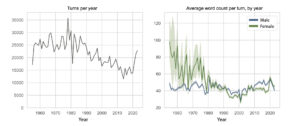
Figure 1. Conversation Turns and Average Word Length by Year[130]
Figure 2, below, depicts the proportion of conversation turns spoken by women (green) and by men (blue) during oral arguments. This Figure includes all conversation turns, whether by advocates or Justices. The most obvious trend to note is the increase in female conversation turns over time.
In the early years of our dataset, female oral argument participants had few conversation turns relative to male participants. Indeed, in 1955, the first year of our dataset, less than 1 percent of conversation turns are attributed to women. This is consistent with historical records of those early oral arguments. In the 1957 volume of the Journal of the Supreme Court of the United States, which catalogues the details of all cases considered by the Court, we find only three cases in which women argued before the Court.[131] This is unsurprising: From 1950 to 1970, less than 5 percent of attorneys in the United States were women.[132]
Over time, however, the proportion of female conversation turns has gradually increased, rising to account for more than one-third of all conversation turns in 2024. This increase parallels the overall rise in female attorneys and judges in the United States[133] but, interestingly, outpaces the increase in oral arguments made by women at the Supreme Court over the same time period. While women were responsible for just over 15 percent of oral arguments during 2015,[134] more than 20 percent of conversation turns for that year were by women. There are many possible explanations for this. As examples, female Justices’ conversation turns might account for the gap, or interruptions to women’s arguments or questions may result in more—but shorter—conversation turns for women.[135]
The vertical dashed lines in Figure 2 mark the confirmation years of each female Justice (also annotated are the years when Justices Sandra Day O’Connor and Ruth Bader Ginsburg left the Court). There is a clear inflection point in the proportion of female conversation turns at the year of Justice Sandra Day O’Connor’s confirmation. Some of that increase is quite likely due to the introduction of Justice O’Connor’s conversation turns during oral argument. Some may reflect the rapid increase in the number of female attorneys during the 1990s: While the total number of women lawyers in the United States increased from 3 percent to 8 percent between 1970 and 1980, that number increased from 8 percent to 20 percent between 1980 and 1991.[136]
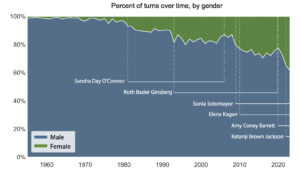
Figure 2. Conversation Turns by Gender Over Time[137]
Comparing “Women’s Language” Usage by Speaker’s Gender
Figure 3 depicts men’s and women’s average rates of usage for each “women’s language” trope per oral argument and provides a visual comparison of the averages for men and women for each trope. As the Figure shows, female oral argument participants used each of the four “women’s language” tropes more frequently than male oral argument participants,[138] even accounting for the uncertainty range.[139] This result is noteworthy. As we explained above, past studies of “women’s language” have disagreed about whether and to what extent “women’s language” exists.[140] But our study, the first analysis of “women’s language” in the Supreme Court context, provides support for Lakoff’s hypothesis that women and men speak differently. At least during oral argument, women seem to hedge more, intensify more, hesitate more, and use more polite forms than male participants, and they do so more than men at a consistent rate across all tropes.
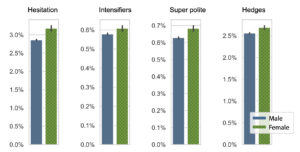
Figure 3. Average Rate of Usage of Each “Women’s Language” Trope, by Gender[141]
Figure 4 below represents the aggregated comparison of female speakers’ and male speakers’ “women’s language.” As shown in the Figure, women’s rate of “women’s language” is more than half a percentage point higher than men’s. Put in relative terms, women’s rate of “women’s language” usage is 108.3 percent of men’s. This is not surprising, given the consistent pattern observed in each individual trope throughout the dataset.
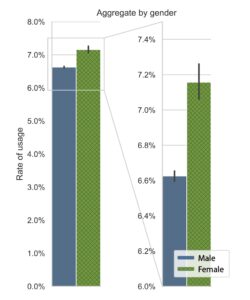
Figure 4. Average Rate of Usage of All “Women’s Language” by Gender[142]
Comparing “Women’s Language” Usage by Role
As discussed in Part I above, some past researchers have suggested that “women’s language” might be a function of a speaker’s relative power rather than a function of gender. O’Barr and Atkins, for example, found that in their study of trial courtrooms, “powerful” speakers (i.e., speakers who have high social standing or special status in the court) used “women’s language” less frequently than “powerless” speakers.[143] To explore this possibility, we separated our data by speaker role: advocate and Justice.[144] Figure 5 depicts this division. The colored bars represent the average rate of usage per oral argument for each of four categories: male advocate, male Justice, female advocate, and female Justice.
As the Figure shows, within each role, men use “women’s language” less than their female counterparts do. That is, male Justices use “women’s language” less than female Justices do, and male advocates use “women’s language” less than female advocates do. This result is consistent with Lakoff’s hypothesis that “women’s language” varies by gender. This result also casts some doubt on O’Barr and Atkins’s competing power hypothesis. Among Justices, there is no significant difference in power as social standing: All Justices have elite academic credentials, all were nominated by the president and confirmed by the Senate, and so on. And though advocates may have different social statuses, they nonetheless enjoy the same status before the Supreme Court. In short, there is no meaningful variation in power in either the Justice group or the advocate group. And yet, we continue to see gendered differences in “women’s language” usage within each group. If power, rather than gender, explained “women’s language” usage, we would expect no variations in “women’s language” where, as here, power is held relatively constant. That gender variations persist even after we control for power (by separating our dataset by role) suggests that gender has some effect on speech patterns.
Our findings cast further doubt on O’Barr and Atkins’s argument by revealing a second, unexpected dynamic. When we compare “women’s language” usage across roles, rather than across genders, we see that Justices use more “women’s language” than their advocate counterparts. That is, female Justices use “women’s language” more than female advocates do, and male Justices use “women’s language” more than male advocates do. If O’Barr and Atkins’s power hypothesis were correct, we would expect to see the opposite result: Advocates, the less powerful party in an oral argument, would use more “women’s language” than Justices. Our contrary finding thus undermines the idea that “women’s language” is related to power rather than gender, at least at the Supreme Court. If anything, our results suggest that a contrary dynamic is at play: “Women’s language” may correlate with higher relative standing in an oral argument.
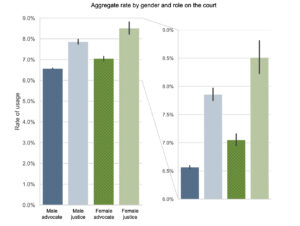
Figure 5. Average Rate of Usage of All “Women’s Language” Usage Per Oral Argument by Role and Gender[145]
It is difficult to explain why a higher status—that of Justice—might correlate with increased use of “women’s language.” It is possible that this dynamic is merely an artifact of high‑stakes litigation at the Supreme Court. Only a small percentage of attorneys in the United States have argued or will ever argue before the Supreme Court,[146] and the results of a Supreme Court case are significant to the litigants and to the country at large. As a result, advocates spend an enormous amount of time preparing for oral argument. By the time advocates argue before the Court, they have spent weeks refining and rehearsing, often in front of a panel of other attorneys who raise questions they believe the Justices are likely to ask. Thus, an advocate’s oral argument, including responses to questions, is highly polished.
Further, across the board, “women’s language” tropes are not associated with the confidence and assertiveness that public speaking guides encourage.[147] Lakoff herself denigrates “women’s language” in her initial writings about the phenomenon, suggesting that it “relegate[s] women to certain subservient functions” and makes it appear that women are “unable to speak precisely or to express [themselves] forcefully.”[148] It is no surprise, then, that advocates of all genders might practice, edit, and rehearse to deliberately avoid “women’s language” in their arguments.
To explore whether the rehearsed nature of the advocates’ oral arguments might help explain the difference between advocates’ and Justices’ use of “women’s language,” we isolated every conversation turn that begins with “May it please the Court.” We assume these conversation turns, which we will call “opening statements,” are the beginning of an advocate’s oral argument and are highly rehearsed and possibly memorized. These conversation turns are not responses to Justices’ questions and represent the advocate’s attempt to set the tone for her or his argument.
Our results provide evidence that rehearsed conversation turns contain less “women’s language” than more spontaneous conversation turns. Figure 6 depicts individual “women’s language” trope usage in male and female opening statements and in the rest of oral argument. We see that both men and women use significantly fewer hesitations and intensifiers during their opening statements than they do across all oral argument speech. In fact, the rate for hesitations and intensifiers in opening statements for both male and female advocates is about half the rate across all oral argument. Notably, female advocates use intensifiers less in opening statements than their male counterparts do: This is the only instance where we see male advocates use more “women’s language” than female advocates even when accounting for uncertainty ranges. Because of the rehearsed nature of opening statements, we speculate the higher rate of intensifiers in male advocates’ opening statements represents an intentional choice meant to persuade or show confidence. However, we cannot explain why women would not also choose to use as many intensifiers in their opening statements.
For super polite forms, we see a different result: Advocates, regardless of gender, appear to use more super polite forms in opening statements than across all oral argument. Because opening statements follow rigid formality norms that involve a high number of super polite terms (for example, “May it please the Court”—the very phrase we used to identify opening statements—includes a super polite form), we do not find this result meaningful. For hedges, the rates are nearly the same in opening statements and across all speech for both female and male advocates. As with super polite forms, we do not assign much meaning to that result. Opening statements often include broad overviews of legal doctrine because advocates are trying to introduce their arguments quickly and succinctly. It makes sense, then, that advocates would use terms like “generally” and “usually” at the beginning of their presentations.
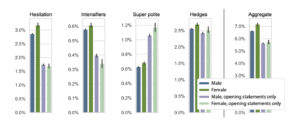
Figure 6. Average Rate of Usage for Each “Women’s Language” Trope in Opening Statements by Gender[149]
Justices’ participation in oral argument differs dramatically from that of the advocates. Justices’ questions and interjections are less likely to be rehearsed and polished in a way that eliminates “women’s language” tropes. Though Justices surely have topics and themes they would like to explore during oral argument, their questions are often contemporaneous reactions to something the advocate has said rather than a practiced segment of speech. Justices’ conversation turns, then, are not the same as advocates’ conversation turns. One might conclude that the two are not good candidates for comparison and that our finding that the Justices use “women’s language” more than their advocate counterparts holds little meaning. But before drawing that conclusion too hastily, it is worth considering that the very difference between advocates’ and Justices’ speech during oral arguments points to a power dynamic. Justices are not subject to the same pressures to polish and prepare for oral argument precisely because they wield the power in the Court. The reverse is true; advocates must polish and prepare precisely because they are subject to the Justices’ power to decide the case. Supreme Court oral arguments may provide a highly visible example of how power and status are counterintuitively associated with the usage of “women’s language,” and this larger dynamic may play out in other contexts that our methodology could help us explore.
Exploring Historical Trends
Thus far, we have observed clear gender-associated and role-associated patterns in the use of “women’s language” across our entire dataset. We now turn to the historical trajectory of “women’s language” at Supreme Court oral arguments.
Figure 7 below provides a bird’s-eye view of “women’s language” historical trends in oral argument. The right panel, which represents all “women’s language” usage, shows a distinct trend of increasing usage. This is hardly surprising, given the historical increase in female conversation turns during oral arguments[150] and in light of our finding that women use more “women’s language” than their male counterparts do.[151] The participation of more women, who generally use more “women’s language,” should indeed result in increasing “women’s language.” The left panel breaks out the data by individual trope and shows that much of the upward trend is due to increasing hesitation.
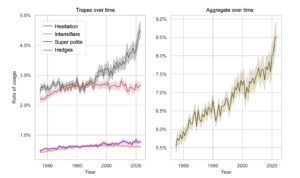
Figure 7. “Women’s Language” Usage Over Time[152]
Figure 8 below adds an unexpected twist to our result. Figure 8 depicts “women’s language” usage by men and women over time. The overall upward trajectory of this Figure parallels the trend we saw in Figure 7. But the fact that both men and women have started using increasingly more “women’s language” during oral argument is unexpected. That is, the increase we see in Figure 7 is not entirely attributable to the increase in female conversation turns and female speech during oral arguments. Men are also using “women’s language” tropes more and more.
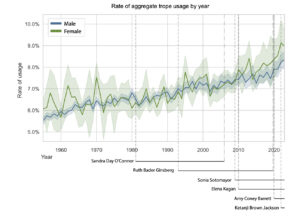
Figure 8. “Women’s Language” Usage, by Gender, Over Time
To further understand the increase in “women’s language,” we separated the data by both role and gender and plotted it across time in Figure 9, below. Consistent with Figures 7 and 8, the overall trend remains largely the same. Advocates and Justices, whether male or female, are using more “women’s language” today than they were in the past. Figure 9, however, reveals that advocates’ use of “women’s language” has increased gradually and relatively evenly when compared to the Justices’ use of “women’s language.”
As seen in Figure 9, the average rate of “women’s language” usage for female Justices and male Justices has several sharp increases and drops. We expected this result for female Justices. We know that female Justices use, on average, more “women’s language” than male Justices do,[153] and the number of women on the Court has historically been small, which amplifies the effect of each addition or retirement to the female Justice’s ranks. The retirement of a female Justice can cut the number of female Justices in half, as it did with the retirement of Justice O’Connor in 2006. Likewise, the appointment of two female Justices in rapid succession can triple that number, as occurred with the appointments of Justices Kagan and Sotomayor in 2009 and 2010. Indeed, we see a drop in female Justices’ rate of “women’s language” in 2006 when Justice O’Connor retired, and increases when Justices Kagan, Sotomayor, Coney Barrett, and Brown Jackson joined. The only counterexample of the general pattern of more female Justices correlating with more “women’s language” by female Justices is a drop after the appointment of Justice Ginsburg. While we did not divide out “women’s language” rates for each Justice, we suspect the drop might be driven by an unusually low rate of “women’s language” from Justice Ginsburg.[154]
What we did not expect from analyzing the trends by gender and role was that male Justices’ use of “women’s language” would generally parallel that of the female Justices. The trend for male Justices includes similar increases and drops that coincide with those of the female Justices. While our methods do not allow us to make causal inferences, it is hard to ignore that these parallel trends have significant inflection points at the year of female Justices’ appointments and retirements. Beginning in 1981, after Justice O’Connor’s appointment, male Justices’ “women’s language” increased and hovered well above where it had been prior to Justice O’Connor’s appointment. Joint increases occurred during several other years as well—in 2010 and 2011, which correspond with the appointments of Justices Kagan and Sotomayor, and in 2020, which corresponds with the death of Justice Ginsburg and the appointment of Justice Barrett. And at Justice O’Connor’s retirement in 2006, we observe sharp decreases in both the female and male Justices’ rate of “women’s language.” In short, when female Justices’ rate of “women’s language” rises or drops, it appears that male Justices’ rate often does the same.
There are also tandem inflection points in male and female Justices’ “women’s language” in years that do not correspond with appointments or retirements. For both female and male Justices, we observe coinciding peaks in 1989 and valleys in 2015. This is not to say that there aren’t instances in which male Justices increase their rate of “women’s language” while female Justices decrease their rate, or vice versa. We see an example of contrary inflection in 2001, when male Justices’ rate of “women’s language” increased at the same time female Justices’ decreased. But the instances of contrary inflection are fewer and less dramatic than the overall comparable trends.
It is curious that male and female Justices’ use of “women’s language” seems to increase and decrease in tandem. If these parallel trends were more subtle and less variable, like the trends for male and female advocates, we might attribute the phenomenon to a general pattern of increasing “women’s language” usage during oral argument. But that is not the case. While our data cannot tell us the cause of the phenomenon, we offer a few possible explanations.
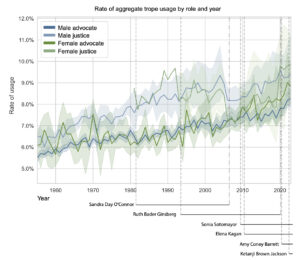
Figure 9. “Women’s Language” Usage by Gender and Role Over Time[155]
One possibility is that Justices mirror each other’s language. Numerous studies document the human tendency to subconsciously mirror each other during conversation. Humans mirror each other’s speech patterns, tone, facial expressions, and body movements.[156] Sometimes called the “chameleon effect,” mirroring can help individuals establish rapport with each other because it communicates shared sentiments, empathy, and equal social status.[157] In experiments, people who feel excessively dissimilar from an important group often mimic that group.[158] The reverse is also true: Existing rapport can result in more mirroring during interactions.[159]
A natural human dynamic, then, may play a role in the similar trends we see in female and male Justices’ “women’s language,” with Justices subconsciously adopting each other’s speech patterns to build rapport. At first blush, though, our data suggest that this mirroring is gendered in a counterintuitive way. Why would eight male Justices significantly increase their “women’s language” usage when one female Justice joins the Court? If anything, it seems more plausible that the Justice who is in the minority—the female Justice—would adopt the language patterns of the majority. But without data on how the Justices speak outside of oral argument (i.e., without knowing whether and how they use “women’s language” in ordinary conversation), we cannot speculate as to whether there is a gendered dynamic to mirroring among the Justices. It may be that female Justices are indeed mirroring their male counterparts and that their “women’s language” usage is less than it would otherwise be during oral argument. A historical analysis of “women’s language” on a Court that starts out with a majority‑male bench but later becomes a majority-female bench may offer clues.
Of course, there are likely many other explanations for the parallel patterns we observe over time, including the idiosyncrasies of one or two Justices. We do not map out the appointment of male Justices in this study, but if a particular male Justice uses significantly more “women’s language” than the others, we would expect the average usage for male Justices to increase during that Justice’s tenure on the Court. This wouldn’t fully explain the parallel peaks and valleys we see in both male and female Justices’ “women’s language,” but it might account for some of the more general trends. Likewise, the subject matter of cases might have an effect on “women’s language.” In years where case subject matters are more technical or less accessible to most of the Justices, we might see more hesitations and hedges.[160] Still, though, any of these explanations seem unlikely to explain male Justices’ increased rates of “women’s language” with the addition of each female Justice.
Whatever the cause of parallel rates of “women’s usage” for male and female Justices, we find the dynamic noteworthy. If it is the case that the presence of women on the bench can cause changes in the speech patterns of their male counterparts, it raises the possibility that the presence of women can affect other aspects of courtroom proceedings and decision-making. Our very brief discussion of possible explanations serves only to flag this issue for future study.
* * *
While we cannot speak conclusively as to the cause of any pattern we observe and describe above, our results show that women—whether advocates or Justices—consistently use “women’s language” more than their male counterparts. This finding alone, which lends credence to Lakoff’s initial hypothesis, has important implications that we more fully discuss in Part IV below. But we have also observed patterns in “women’s language” usage that raise additional questions not addressed by Lakoff’s hypothesis. We observe that men have increasingly used “women’s language” during oral arguments and that Justices use “women’s language” more than advocates of the same gender. We have also found that male and female Justices’ use of “women’s language” has historically risen and fallen in tandem. Below we explore some implications of these findings as well.
Implications
In the last fifty years, countless scholars have responded to, challenged, tested, and complicated Robin Lakoff’s hypothesis that female speakers use a distinct “women’s language.”[161] The foregoing analysis adds to that rich literature by using statistical lexical methods to analyze “women’s language” in Supreme Court oral arguments. As explained above, our analysis shows clear patterns of gendered language at the Supreme Court: Female speakers do, in fact, tend to use the tropes of “women’s language” more frequently than their male counterparts.[162] We also observe that men are increasingly using “women’s language,” and that Justices use “women’s language” more than advocates of the same gender. We also take note of the curious parallel historical trends in male and female Justices’ use of “women’s language.”
These results have important substantive and normative implications. In this Part, we first explain how our findings enhance and complicate prevailing understandings of “women’s language.” Specifically, we describe how our findings contribute to existing debates about the existence of “women’s language.” We also note how our findings complicate the hypothesis that “women’s language” is a function of power rather than of gender. Next, we consider the normative implications of our results. Specifically, we examine “women’s language” both as a symptom of inequality and as a deliberate rhetorical strategy. We then consider how the Supreme Court’s reinforcement of “women’s language” patterns might affect the legal profession, either by perpetuating subordination or by helping to destigmatize the speech style. Finally, we describe avenues for future research.
Substantive Implications
First, and most obviously, our results provide evidence that “women’s language” is, in fact, an observable phenomenon. This contribution is meaningful because, despite fifty years of research, many scholars do not agree that “women’s language” actually exists.[163] Because we are the first to analyze “women’s language” at the Supreme Court, our results provide new reason to believe that women and men speak differently, at least in the oral argument context. Our findings also stem from rich lexical methods, which are more powerful and precise than the manual techniques researchers have used in the past.[164] Though our analysis is, admittedly, quite simple, it reveals clear differences between male and female speech during Supreme Court oral arguments. These findings provide new and important evidence for Lakoff’s original hypothesis.
Our findings also complicate the competing theory—first articulated by William O’Barr and Bowman Atkins—that language varies with power, not with gender.[165] O’Barr and Atkins defined power as “social standing in the larger society and/or status accorded by the court.”[166] At the Supreme Court, nearly every speaker is “powerful” in the former sense: Justices and advocates are all “well-educated, professional,” and of relatively high “social status in the society at large.”[167] But there is a clear hierarchy in “status accorded by the court”: The nine Justices are arguably the most prestigious attorneys in the United States and hold all decision-making power; advocates, by contrast, are experts in their respective cases but have no control over questioning or outcomes. If O’Barr and Atkins’s hypothesis is correct, then, we might expect to see advocates (the less powerful players) using “women’s language” more often than Justices. But as discussed in Section III.C, above, that is not what we found. Instead, our analysis shows that Justices use Lakoff’s tropes at a higher rate than advocates, regardless of gender. These findings are difficult to square with O’Barr and Atkins’s proposition that power, rather than gender, predicts which speakers use Lakoff’s tropes.
Normative Implications
In addition to complicating the existing literature on language, gender, and power, our research raises important normative questions about what “women’s language” means for and about female attorneys and the law. In her original article, Lakoff argued that “women’s language” is both a symptom and source of gender inequities.[168] If this is true, what does “women’s language” at the Supreme Court signify? And what new inequities might it cause?
“Women’s Language” as a Symptom
Participants in Supreme Court oral argument are highly trained, highly educated, and well prepared. For any given case, advocates might spend hundreds of hours rehearsing and mooting their arguments.[169] Justices likewise come prepared with questions and follow-ups. Given how rehearsed and practiced arguments are, it is somewhat surprising that “women’s language”—with all its “ums,” “sorrys,” and stutters—appears at all. The fact that advocates use less “women’s language” during their highly prepared opening statements than during the remainder of oral argument suggests that they recognize (or, perhaps, have been taught) that “women’s language” is not the most effective or powerful way to convey ideas.[170] But if oral argument participants scrub “women’s language” from opening statements, why do they pick it up again during the rest of the argument?
One explanation might be that the women in our dataset do not select “women’s language” consciously at all. As Lakoff notes, little girls who “‘talk[] rough’ like a boy [are] normally . . . ostracized, scolded, or made fun of.”[171] Girls are thus socialized from a young age to use language that is soft, tentative, and hesitant. When they grow to womanhood, Lakoff argues, that socialization process ensures that many women are “unable to speak precisely or to express [themselves] forcefully.”[172] Perhaps that is true even at the Supreme Court: “Women’s language” might be so deeply engrained in societal norms that it naturally creeps into spontaneous speech, even if it can be edited or rehearsed out of opening statements.
The women in our dataset might also default to “women’s language” because they have long occupied a subordinate position in the legal profession.[173] Since its inception, the practice of law has been dominated by men.[174] And despite remarkable gains made in the last fifty years, women remain underrepresented on the bench, in federal clerkships, and in other prestigious legal positions.[175] Given these dramatic and longstanding gender disparities, it is perhaps unsurprising that women still present themselves using language patterns that some perceive as tentative, timid, and weak.
A final, and more optimistic, possibility is that the women in our dataset intentionally select “women’s language” for its communicative advantages. Curiously, Benjamin Franklin recounted doing just that. In his autobiography, he described deliberately using hedges, super polite forms, hesitations, and other tropes that we now associate with “women’s language.” Reflecting on the effects, he wrote, “[T]he conversations I engag’d in went on more pleasantly. The modest way in which I propos’d my opinions procur’d them a readier reception . . . I had less mortification when I was . . . wrong, and I more easily prevail’d with others . . . when I happened to be in the right.”[176] In recent years, some scholars have similarly proposed that “women’s language” can be “used to good effect.”[177] For instance, linguist Jennifer Coates suggests that hedges can help a speaker “respect the . . . needs of all [conversation] participants, . . . negotiate sensitive topics, and . . . encourage the participation of others.”[178] Linguist Janet Holmes urges that “women’s language” improves decision-making, problem-solving, and cooperation, especially in professional settings.[179] And Susan Schick Case, a professor of organizational behavior and gender studies, claims that in complex, multicultural organizations, “certain features of women’s speech . . . influence the performance and goal attainment of the organization as a whole, as well as help in the development of complex and novel decisions that require pulling together perspectives and information from many different groups.”[180]
If these observations are correct, then “women’s language” could be an asset in various professional settings. In the legal field, the ability to “encourage the participation of others” and artfully navigate “sensitive topics” is an essential skill—for negotiations, attorney-client relations, persuading judges and juries, and other purposes.[181] And in any profession, communication that facilitates decision-making, problem-solving, and cooperation is a boon.[182] If “women’s language” yields these advantages, it is possible that the women in our dataset—all sophisticated users of language—intentionally use “women’s language” to achieve their communicative objectives. The patterns we observe might thus be evidence of purposeful rhetorical decisions rather than proof of systemic gender inequality.[183]
“Women’s Language” as a Source
In addition to whatever “women’s language” might reflect about society, the legal profession, and the individual speakers in our dataset, its presence during Supreme Court oral argument has the potential to shape norms and expectations going forward. The Supreme Court is the most prominent judicial institution in the United States, if not the world. Its Justices are admired and revered. And its advocates are considered some of the best in their field. The Court’s proceedings and opinions are studied and emulated in moot court competitions, legal research and writing programs, and doctrinal classes. If young lawyers see participants in Supreme Court oral arguments using “women’s language,” they may consciously or subconsciously learn that “women’s language” is how good female attorneys speak. The result might be that young female lawyers emulate the “women’s language” they observe, while young male lawyers come to expect “women’s language” from their female colleagues.
Whether this is beneficial or problematic depends on how one assesses “women’s language” to begin with. If Lakoff is correct that “women’s language” “systematically deni[es] [women] access to power,”[184] there is reason to worry that the Supreme Court is modeling—and by extension perpetuating—norms of gender inequality and subordination. In the legal field, strong communication skills are vital to career advancement. Attorney speech is evaluated in interviews, at trial, in oral argument, and in interactions with coworkers. So, if “women’s language” is in fact a source and sign of weakness, women in the legal profession may be marked as less sophisticated because they use it. They might also face the added—and in many ways invisible—hurdle of scrubbing “women’s language” from their vernacular. Whether women choose to proceed using “women’s language” or not, they could face heightened scrutiny compared to their male counterparts as society polices and penalizes their communication style.
If, however, Coates, Case, and others are correct that “women’s language” has communicative benefits,[185] then perhaps we ought to rejoice that these rhetorical techniques are on display at the Supreme Court for Americans of all genders and professions. If “women’s language” is a valuable rhetorical tool, then there is good reason for the legal profession to welcome, celebrate, and elevate those who use it. And if male attorneys begin using more “women’s language” (as we see them doing at the Supreme Court), then the entire legal field might benefit from its relationship-facilitating, cooperation-inducing effects. Put differently, “women’s language” might be one of the many ways that female lawyers have “feminized” the legal profession for the better.[186]
Paths Forward
Like all studies, our analysis is limited. Though we analyzed an enormous amount of text, our corpus did not contain many instances of “women’s language,” because until recently, there were not many women on or at the Supreme Court. Thus, especially for the earlier years in our dataset, our findings are noisy. Additionally, we only analyzed four of Lakoff’s tropes, so we did not capture the full spectrum of what Lakoff considers “women’s language.” And we used Lakoff’s original framework without any of the modifications or revisions that subsequent scholars have added.[187] A sociolinguist might thus object that our framework is incomplete or outdated. They would probably be right.
Notwithstanding these limitations, our analysis is the first to study “women’s language” during Supreme Court oral arguments. And it provides clear evidence that “women’s language” exists in that context. Our study thus makes an important preliminary contribution to the study of gender, language, and law.
As the first of its kind, though, our analysis leaves many questions unanswered. We hope that future researchers will continue what we have begun by asking deeper and more nuanced questions about gender, language, and the law. For example, as researchers have done in other fields, legal scholars might analyze whether “women’s language” affects the way speakers are perceived or received—for example, whether female Justices who use “women’s language” are seen as less competent or capable than their male colleagues.[188] Legal scholars might likewise consider whether “women’s language” affects the substantive outcome of a case. Future researchers could also ask whether “women’s language” varies depending on the subject matter of the case—for example, if female speakers use less “women’s language” in cases that involve women’s issues. They might also analyze whether “women’s language” varies depending on the gender of the listener.[189]
Most importantly, though, future researchers should explore the normative implications of “women’s language” in the law. As we have noted, the “women’s language” we observe during Supreme Court oral arguments might be either positive or negative—an intentional, strategic rhetorical choice or a symptom of systemic inequality. Because our goal in this Article has simply been to identify “women’s language,” we have not taken a normative stance on whether the phenomenon is discouraging or hopeful. We hope future researchers will take up that task. Experiments and interviews could help determine whether “women’s language” in oral argument and other legal contexts has the positive, communication-facilitating effects that scholars like Coates, Case, and Holmes posited.[190] Ethnographic research might also help us understand whether speakers use “women’s language” intentionally (which would suggest that it is a deliberate and strategic choice) or habitually (which might indicate that “women’s language” is symptomatic of a deeper social problem). These and other efforts to understand the normative significance of “women’s language” will better equip legal scholars and practitioners to respond to and address its effects.
Conclusion
In business, healthcare, education, sociology, linguistics, and other fields, scholars have spent considerable energy researching how women use language to construct their social and professional identities.[191] In law, by contrast, we know very little about how women express themselves. This paper has begun to fill that gap by providing a first-of-its-kind study of female speech during Supreme Court oral arguments. Specifically, we used lexical methods to identify and analyze four tropes of “women’s language” in a corpus of more than six thousand oral arguments, and we found clear evidence that women participants in oral argument use each of those tropes more than their male counterparts.
These findings prompt important questions about women’s status in the legal profession. Since the early 1970s, scholars of gender and discourse have suggested that “women’s language” is both a symptom and source of gender inequality. Even so, other studies have argued that “women’s language” can be a valuable rhetorical tool that fosters cooperation and improves decision-making.[192] If it is true that “women’s language” signals inequality, then the prevalence of “women’s language” at the Supreme Court suggests that, notwithstanding their ever-increasing numbers, women in the law are not (or do not feel) equal. But regardless of which view is correct, scholars interested in gender, language, power, and equality ought to take seriously this possibility—especially at a time when issues of women’s legal rights are increasingly before the Court.
** Professorial authors are listed first in alphabetical order by last name, followed by professional authors in alphabetical order by last name. The authors would like to thank the many brilliant people who helped bring this project to fruition, including (but not limited to): Tom Lee, Annalee Hickman Pierson, the faculty at the Chase College of Law (Northern Kentucky University), the participants at the 2025 Law and Society annual meeting, and the excellent editors at the Colorado Law Review.
† J.D., Charles E. Jones Professor of Law, J. Reuben Clark Law School, Brigham Young University.
‡ J.D., Ph.D., Associate Professor, J. Reuben Clark Law School, Brigham Young University.
** Ph.D., Associate Professor, Brigham Young University Department of Computational, Mathematical, and Physical Sciences.
†† J.D., J. Reuben Clark Law School, Brigham Young University.
‡‡ J.D., J. Reuben Clark Law School, Brigham Young University.
- Robin Lakoff, Language and Woman’s Place, 2 Language Soc’y 45, 48 (1973). ↑
- Bradwell v. Illinois, 83 U.S. 130 (1872). ↑
- Id. at 141 (Bradley, J., concurring). ↑
- Indeed, Bradwell might qualify as a part of the American anticanon. See Jamal Greene, The Anticanon, 125 Harv. L. Rev. 379, 464 (2011) (suggesting that “anticanon” cases are cases that are theorized incompletely and “inconsistent[] with [America’s national] ethos” but nonetheless reflect methods of legal reasoning that, at some level, seem correct). ↑
- Women in the Legal Profession, ABA (2024), https://www.americanbar.org/news/profile-legal-profession/women [https://perma.cc/V6S9-QG7R]. ↑
- Id. ↑
- Id. Though this number is a significant improvement, it is obviously still not proportionate to the number of women in the general population or to the increasing number of women in the legal field. ↑
- Id. (“[M]en still dominate the upper echelons of the legal profession through federal judgeships, state supreme courts, law firm partnerships, and corporate counsel positions.”). ↑
- We recognize that “woman” and “female” are not synonymous. However, following Lakoff, we use these terms interchangeably to refer to a gender identity.We also use the traditional gender binary that Lakoff used when she first conceptualized “women’s language.” We realize that this binary lacks nuance and is not inclusive of all gender identities. But we feel comfortable proceeding with the male/female binary for two reasons. First, the literature we build on and engage with in this Article presupposes the male/female binary. Second, the first openly trans person argued before the Supreme Court in December 2024. Lindsay Whitehurst, First Transgender Attorney to Argue Before the Supreme Court, Challenging Health Care Ban for Minors, Associated Press (Aug. 25, 2025, at 7:48 AM), https://apnews.com/article/supreme-court-genderaffirming-care-minors-tennessee-trump-a6b408e7531ec4ac4826ce692e381cfb [https://perma.cc/8ABF-CE77]. For the vast majority of cases then, the male/female binary accurately captures the public‑facing identities of the speakers in our dataset. ↑
- See, e.g., Laura T. Kessler, Reproductive Justice at Work: Employment Law After Dobbs v. Jackson Women’s Health Organization, 109 Cornell L. Rev. 1447 (2024) (explaining how the Dobbs decision affected women’s families and economic security); Melissa Murray, Race-ing Roe: Reproductive Justice, Racial Justice, and the Battle for Roe v. Wade, 134 Harv. L. Rev. 2025 (2021) (discussing the racial dynamics of abortion); Aaron Tang, After Dobbs: History, Tradition, and the Uncertain Future of a Nationwide Abortion Ban, 75 Stan. L. Rev. 1091 (2023) (discussing the future of abortion regulations after Dobbs); Impediments to Reproductive Justice: The Criminal Legal System and American Carceral State, 137 Harv. L. Rev. 2320 (2024) (discussing the intersection of reproductive rights and the American criminal justice system). ↑
- See, e.g., Cheryl Hanna, No Right to Choose: Mandated Victim Participation in Domestic Violence Prosecutions, 109 Harv. L. Rev. 1849 (1996) (examining the tensions created when the state requires women to participate in the prosecution of their abusers); Erin R. Collins, The Evidentiary Rules of Engagement in the War Against Domestic Violence, 90 N.Y.U. L. Rev. 397 (2015) (discussing the implications of unique evidentiary practices of domestic violence prosecutions); Gemma Donofrio, Dobbs, Bruen, and Domestic Violence: Fewer Abortions, More Guns, and the Effects of Both on Survivors of Intimate Partner Violence, 102 N.C. L. Rev. 699 (2024) (exploring how developments in privacy law and firearms law may affect domestic violence). ↑
- See, e.g., Ines Zamouri, Self-Defense, Responsibility, and Punishment: Rethinking the Criminalization of Women Who Kill Their Abusive Intimate Partners, 30 UCLA J. Gender & L. 209 (2023) (discussing the incarceration of women who kill their abusive partners); Aleta Wallach & Larry Rubin, The Premenstrual Syndrome and Criminal Responsibility, 19 UCLA L. Rev. 209 (1971) (analyzing how premenstrual syndrome influences criminal behavior). ↑
- See, e.g., Kerry Abrams, Family, Gender, and Leadership in the Legal Profession, Women & L., Special Joint Publ’n Issue 2020, at 1 (analyzing women’s advancement in the legal field in light of family and gender norms and dynamics); Bradley Soule & Kay Standley, Perceptions of Sex Discrimination, 59 ABA J. 1144 (1973) (comparing sex discrimination in the legal field to other professions); S. Elizabeth Foster, The Glass Ceiling in the Legal Profession: Why Do Laws Firms Still Have So Few Female Partners, 42 UCLA L. Rev. 1631 (1995) (examining the disparity between male and female partners at law firms); Ruth Bader Ginsburg, Women at the Bar—A Generation of Change, 2 U. Puget Sound L. Rev. 1 (1978) (describing legal and social developments that have inhibited and benefited women in the law); Mallika Balachandran et al., Speak Now: Results of a One-Year Study of Women’s Experiences at the University of Chicago Law School, 2019 U. Chi. Legal F. 647 (summarizing a year-long study of the differences between the male and female experiences at law school). ↑
- See, e.g., Michael A. Livermore et al., Gendered Judicial Opinions, 1 J.L. & Empirical Analysis 1 (2024) (“[G]ender is a significant predictor of the content of judicial opinions.”); Christina L. Boyd, Lee Epstein & Andrew D. Martin, Untangling the Causal Effects of Sex on Judging, 54 Am. J. Pol. Sci. 389 (2010) (using semiparametric matching to argue that gender is a consistent predictor of outcome in only one area of the law—sex discrimination); F. Elaine Martin, Differences in Men and Women Judges: Perspectives on Gender, 17 J. Pol. Sci. 74 (1989) (exploring the differences between male and female judges in an early paper); Phyllis Coontz, Gender and Judicial Decisions: Do Female Judges Decide Cases Differently than Male Judges?, 18 Gender Issues 59 (2000) (finding that judge gender affects case outcomes in state trial courts); see also Jeffrey J. Rachlinski & Andrew J. Wistrich, Benevolent Sexism, 58 S.D. L. Rev. 101 (describing how gender affects sentencing). ↑
- See, e.g., Balachandran et al., supra note 13 (summarizing a one-year study which highlighted the differences between the men’s and women’s experiences at law school); Tonja Jacobi & Dylan Schweers, Justice, Interrupted: The Effect of Gender, Ideology, and Seniority at Supreme Court Oral Arguments, 103 Va. L. Rev. 1379 (2017) (finding that female Justices are interrupted during oral arguments at “disproportionate rates by their male colleagues, as well as by male advocates”); Christina L. Boyd et al., Gender, Race, and Interruptions at Supreme Court Confirmation Hearings, 119 1 Am. Pol. Sci. Rev. 492 (2025) (finding that “male and white participants are more likely to interrupt women and person of color speakers” during U.S. Supreme Court confirmation hearings from 1939 to 2022). ↑
- See, e.g., Janet Holmes, Gendered Discourse at Work, 2 Lang. Linguistics Compass 478 (2008) (summarizing key themes that have emerged from research on gendered interaction in the workplace); Janet Holmes, Power and Discourse at Work: Is Gender Relevant?, in Feminist Critical Discourse Analysis 31 (Michelle M. Lazar ed., 2005) (discussing dynamics of power and gender in the workplace); Louise Mullany, Gendered Discourse in the Professional Workplace (2007) (investigating the role of gendered discourse in workplace inequality); Ruth Wodak, Gender and Discourse (1997) (a collection of writings analyzing gendered discourse from theoretical and practical perspectives); Janet Holmes, Professor, Sch. of Linguistics & Applied Language Stud., Victoria Univ. of Wellington, The Glass Ceiling – Does Talk Contribute? Gendered Discourse in the New Zealand Workplace (2005) (on file with ResearchGate) (discussing how leadership in a business context has traditionally been considered masculine and how that has affected feminine leaders). ↑
- See, e.g., Sarah Payne, Constructing the Gendered Body? A Critical Discourse Analysis of Gender Equality Schemes in the Health Sector in England, 62 Current Socio. 956 (2014) (discussing the potential drawbacks of “gender mainstreaming” in the health sector); Sylvia Jaworska & Kath Ryan, Gender and the Language of Pain in Chronic and Terminal Illness: A Corpus-Based Discourse Analysis of Patients’ Narratives, 215 Soc. Sci. & Med. 107 (2018) (finding significant differences in the way men and women report and communicate pain levels and discussing repercussions in healthcare); Navin Kariyawasam et al., Beyond Inclusion Politics: A Critical Discourse Analysis of Sex and Gender in Medical Education, 59 Med. Educ. 302 (2024) (describing how “medical education governs and reinforces gender norms”). ↑
- See, e.g., Julia Davies, Expressions of Gender: An Analysis of Pupils’ Gendered Discourse Styles in Small Group Classroom Discussions, 14 Discourse & Soc’y 115 (2003) (exploring how boys’ language patterns undermine their learning while girls’ language patterns contribute to their achievement in educational settings); Vibeke G. Aukrust, Boys’ and Girls’ Conversational Participation Across Four Grade Levels in Norwegian Classrooms: Taking the Floor or Being Given the Floor?, 20 Gender & Educ. 237(2008) (analyzing different strategies used by boys and girls to “take the floor” in Norwegian classrooms). ↑
- See, e.g., Erving Goffman, Interaction Ritual: Essays on Face‑to‑Face Behavior 5 (1967) (discussing the concept of face, “an image of self‑delineated in terms of approved social attributes”); Penelope Brown, How and Why Are Women More Polite: Some Evidence from a Mayan Community, in Women and Language in Literature and Society 111 (Sally McConnell-Ginet, Ruth Borker & Nelly Furman, eds., 1980) (examining the politeness of men and women in a Mayan community). ↑
- See, e.g., Lakoff, supra note 1; Deborah Tannen, You Just Don’t Understand: Women and Men in Conversation (1990) (arguing to a general audience that conversations between men and women might be better understood as cross-cultural communication). ↑
- Louise Mullany, Discourse, Gender and Professional Communication, The Routledge Handbook of Discourse Analysis 509 (James Paul Gee & Michael Hardford eds., 2012). ↑
- See, e.g., Jacobi & Schweers, supra note 15, at 1379; Jessica M. Salerno et al., Closing with Emotion: The Differential Impact of Male Versus Female Attorneys Expressing Anger in Court, 42 Law & Hum. Behav. 385 (2018) (finding that people reacted negatively to women showing anger in a closing statement). ↑
- Lakoff, supra note 120, at 45 (speaking of the marginality and powerlessness reflected and enforced by “women’s language”). ↑
- See infra Figure 2 and accompanying text. ↑
- See infra notes 82–84 and accompanying text. ↑
- See, e.g., Lakoff, supra note 1, at 46 (using introspection as her method of analysis); Frances Sayers & John Sherblom, Qualification in Male Language as Influenced by Age and Gender of Conversational Partner, 4 Commc’n Rsch. Reps. 88, 89 (1987) (using computer analysis of transcripts to generate frequency counts); William M. O’Barr & Bowman K. Atkins, “Women’s Language” or “Powerless Language”?, in Women and Language in Literature and Society 93 (Sally McConnell-Ginet, Ruth Borker & Nelly Furman eds., 1980) (manually coding over 150 hours of trial transcripts to find women’s language); Anthony Mulac et al., Male/Female Language Differences and Effects in Same-Sex and Mixed-Sex Dyads: The Gender-Linked Language Effect, 55 Commc’n Monographs 315 (1988) (using trained observers to code for women’s language from transcripts of recorded interactions between university students); Peter Kollock et al., Sex and Power in Interaction: Conversational Privileges and Duties, 50 Am. Socio. Rev. 34 (1985) (manually coding for women’s language by listening to tape-recorded interviews); Annette Hannah & Tamar Murachver, Gender Preferential Responses to Speech, 26 J. Lang. Soc. Psych. 274 (2007) (using research assistants to code for women’s language from video- and audio-recorded conversations). ↑
- Lakoff, supra note 1, at 47–48. ↑
- See infra notes 55, 177–181 and accompanying text. ↑
- Dobbs v. Jackson Women’s Health Org., 597 U.S. 215 (2022) (holding that the Constitution does not contain an implied federal right to an abortion). ↑
- Adeel Hassan, States Passed a Record Number of Transgender Laws. Here’s What They Say, N.Y. Times (June 27, 2023, at 5:56 PM), https://www.nytimes.com/2023/06/27/us/transgender-laws-states.html [https://perma.cc/C9ER-YUSC]. ↑
- Id. ↑
- Exec. Order No. 14,168, 90 Fed. Reg. 8615 (Jan. 20, 2025). The Order is titled “Defending Women from Gender Ideology Extremism and Restoring Biological Truth to the Federal Government” and states, “It is the policy of the United States to recognize two sexes, male and female.” Id. ↑
- Shari Kendall & Deborah Tannen, Discourse and Gender, in 1 The Handbook of Discourse Analysis 639, 639 (Deborah Tannen, Heidi E. Hamilton & Deborah Schiffrin eds., 2d ed. 2015). ↑
- Id. ↑
- For descriptions of these methods and examples of how they function in gender and language studies, see Mary Bucholtz, Theories of Discourse as Theories of Gender: Discourse Analysis in Language and Gender Studies, in The Handbook of Language and Gender 43 (Janet Holmes & Miriam Meyerhoff eds., 2003); Ruth Wodak, Gender and Language Research Methodologies (2008). ↑
- According to Kendall and Tannen, Lakoff’s research “proved pivotal” in “launching the field of language and gender,” and her article “Language and Woman’s Place” was and is “the field’s foundational text.” Kendall & Tannen, supra note 33, at 640. ↑
- Lakoff, supra note 1, at 49, 57. Lakoff’s argument had two parts. First, Lakoff argued that women speak differently than men and that women’s linguistic tendencies systematically deny them access to power. Second, Lakoff claimed that the way society speaks about women reinforces women’s subordinate social status. In this Article, we focus exclusively on Lakoff’s first claim. ↑
- Id. at 49. ↑
- Id. at 50. ↑
- Id. at 51–53. ↑
- Id. at 55–56 (“There is a peculiar sentence intonation-pattern, found in English as far as I know only among women, which has the form of a declarative answer to a question, and is used as such, but has the rising inflection typical of a yes-no question, as well as being especially hesitant. The effect is as though one were seeking confirmation, though at the same time the speaker may be the only one who has the requisite information.”). ↑
- Id. at 53–54. ↑
- Robin Tolmach Lakoff, Language and Woman’s Place: Text and Commentaries 79 (Mary Bucholtz ed., Oxford Univ. Press 2004, repr. 2008). ↑
- Id. ↑
- Id. at 80 (explaining that women are more likely than men to use language that is grammatically correct). For example, women also use terms like “ain’t” less frequently and are less likely to drop the g at the end of gerunds (e.g., “goin’” or “singin’”). Id. ↑
- Id. (arguing that women are regarded as “repositories of tact,” and as such, they are more likely to use phrases and terms that are particularly formal or polite: please, thank you, excuse me, etc.). ↑
- Lakoff, supra note 1, at 55. ↑
- Lakoff, supra note 43, at 79. ↑
- Lakoff, supra note 1, at 51. ↑
- Id. at 49. According to Lakoff, women use precise color terms because they “are not expected to make decisions on important matters, like what kind of job to hold, [and] are relegated the non-crucial decisions”—decisions like how to describe a color—“as a sop.” Id. ↑
- Id. at 48. ↑
- Id. ↑
- See, e.g., Campell Leaper & Rachael D. Robnett, Women Are More Likely Than Men to Use Tentative Language Aren’t They? A Meta-Analysis Testing for Gender Differences and Moderators, 35 Psych. Women Q. 129, 130 (2011) (completing a metadata analysis of twenty-nine empirical studies testing Lakoff’s claims between 1977 and 2008 collecting sources); see also Lakoff, supra note 43. ↑
- See, e.g., O’Barr & Atkins, supra note 26, at 104, 109 (arguing that “instead of being primarily sex-linked, a high incidence of some or all of [Lakoff’s tropes] appears to be more closely related to social position in the larger society and/or the specific context of the courtroom”); Nancy Henley, Body Politics: Power, Sex, and Nonverbal Communication 2 (1977) (proposing that “observed ‘sex differences,’ ‘race differences,’ and ‘class differences’ in non-verbal behavior may be traced to differences in power; and that these are learned differences which serve to strengthen the system of power and privilege that exists.”). But see Kollock et al., supra note 26, at 34 (reporting experimental data suggesting that not all of Lakoff’s tropes are clearly linked to power). ↑
- See, e.g., Leaper & Robnett, supra note 53, at 130–32 (noting that “[t]he majority of psychological research is conducted with college-age participants, which raises the question of how well the results of these studies generalize to other age groups”). ↑
- See, e.g., Janet Holmes, Functions of You Know in Women’s and Men’s Speech, 15 Language Soc. 1 (1986) (comparing patterns of women’s language between British English speakers and New Zealand English speakers); Lakoff, supra note 43, at 252 (clarifying that Lakoff’s work was based on her “observations and intuitions as a middle-class white woman” and that much of the linguistic research on women’s language was specific to white women). ↑
- See, e.g., Kay Deux & Brenda Major, Putting Gender into Context: An Interactive Model of Gender-Related Behavior, 94 Psych. Rev. 369 (1987) (noting people behave in gendered ways when interacting with strangers because more approval for gender conforming); Dédé Brouwer et al., Speech Differences Between Women and Men: On the Wrong Track?, 8 Language Soc’y 33 (1979) (finding that the sex of an addressee may affect language patterns more than the sex of the speaker); Juhe R. McMillan et al., Women’s Language: Uncertainty or Interpersonal Sensitivity and Emotionality?, 3 Sex Roles 545, 554 (1977) (noting what their findings teach about women’s subculture); Linda L. Carli, Gender, Language, and Influence, 59 J. Pers. & Soc. Psych. 941 (1990) (noting studies that suggest that men and women speak differently in mixed-sex groups as compared to same-sex groups). ↑
- See Carli, supra note 57, at 942 (“[T]he use of intensifiers and verbal reinforcers[] appear to be less a reflection of women’s greater tentativeness than of their greater emotional expressiveness and sociability.”); Janet Holmes, Women, Men and Politeness (Jennifer Coates, Jenny Cheshire & Euan Reid eds., 1995) (arguing that hedges express interpersonal warmth, not tentativeness); John A. Dixon & Don H. Foster, Gender and Hedging: From Sex Differences to Situated Practice, 26 J. Psycholinguistic Rsch. 89 (1997) (finding that “contextual influences eclipsed the effects of gender”). ↑
- See Faye Crosby et al., Gender, Androgyny, and Conversational Assertiveness, in Gender and Nonverbal Behavior 151, 154 (Clara Mayo & Nancy M. Henley eds., 1981) (considering whether and how a speaker’s “sex-role self-concept” affects speech patterns); Carli, supra note 57, at 942 (noting that existing beliefs about the stereotypical behavior of men and women “may be self-fulfilling”). ↑
- See Monica Hersh Khetarpal Sholar, Jurors’ Perceptions of Gender-Based Linguistic Differences, 10 Wm. & Mary J. Women & L. 91, 111 (2003) (“The results of this study indicate that the male version of the testimony elicited a more positive response from jurors than the female version of the testimony. Specifically, jurors thought those witnesses reading the male script were more persuasive, more knowledgeable about the events surrounding the accident, more competent, more articulate, and more confident.”). ↑
- Bonnie Erickson et al., Speech Style and Impression Formation in a Court Setting: The Effects of “Powerful” and “Powerless” Speech, 14 J. Exp. Soc. Psych. 266 (1978) (finding that witnesses who speak in a powerful style—avoiding women’s language—are considered more attractive). ↑
- See Carli, supra note 57, at 94 (finding that women who used features of Lakoff’s “women’s language” were more influential with men and less influential with women); Erickson et al., supra note 61, at 266 (finding that for witnesses “the powerful style produced more acceptance of the position advocated in the testimony than did the powerless style”); Sholar, supra note 60, at 111 (“The results of this study indicate that the male version of the testimony elicited a more positive response from jurors than the female version of the testimony.”). ↑
- Dixon & Foster, supra note 58, at 90–91 (discussing Janet Holmes’s work on hedging). ↑
- Susan Schick Case, Cultural Differences, Not Deficiencies: An Analysis of Managerial Women’s Language, in Women’s Careers: Pathways and Pitfalls 41 (Suzanna Rose & Laurie Larwood eds., 1988). For a discussion of the many ways speakers use these language patterns advantageously, see infra notes 176–180 and accompanying text. ↑
- Lakoff, supra note 1, at 46. (“The data on which I am basing my claims have been gathered mainly by introspection: I have examined my own speech and that of my acquaintances, and have used my own intuitions in analyzing it.”). ↑
- See, e.g., Leaper & Robnett, supra note 53, at 130 (completing a metadata analysis of twenty-nine empirical studies testing Lakoff’s claims between 1977 and 2008 collecting sources); see also infra notes 73–75 and accompanying text for a summary of the results of these empirical studies. ↑
- O’Barr & Atkins, supra note 26. ↑
- Id. at 109. ↑
- Id. at 102–03. ↑
- Id. at 102. ↑
- Id. at 103. Scholars since O’Barr and Atkins’s seminal work have divided over whether the speech phenomenon that Lakoff originally observed should rightfully be called “women’s language,” “powerless language,” or something else entirely. See, e.g., Leaper & Robnett, supra note 53, at 130 (preferring to call the language patterns Lakoff originally observed “tentative language”). We have chosen to use the term “women’s language” because while “women’s language” is certainly much more complicated than Lakoff originally described, we do not think that the powerless language framework has entirely replaced Lakoff’s foundational framework. O’Barr and Atkins themselves point out that the effects of gender and social position “undoubtedly interact” because of the “all-too-frequent powerless social position of many American women.” O’Barr & Atkins, supra note 26, at 109. Furthermore, we do not think that using “women’s language” will always disadvantage the speaker. There is a significant body of literature showing that the language patterns O’Barr and Atkins refer to as “powerless language” are used by women to build interpersonal connection, express empathy, carry conversation, and in other advantageous ways. See infra notes 153–156. No matter what you call it, the existing literature and our analysis makes it clear that while these speech patterns exist, understanding them adequately is a nuanced endeavor. ↑
- See Calvin Morrill & Peter C. Facciola, The Power of Language in Adjudication and Mediation: Institutional Contexts as Predictors of Social Evaluation, 17 Law & Soc’y Inquiry 191, 191 (1992) (reporting experimental data suggesting that “students’ and judges’ evaluations of [witnesses’ and litigants’] credibility, social characteristics, and blame are affected by speech style”); Sholar, supra note 60, at 111 (reporting experimental data suggesting that mock juror’s rated a male script as more persuasive, knowledgeable, competent, articulate, and confident than the female script at a statistically significant higher rate); Andrew E. Taslitz, Forgetting Freud: The Courts’ Fear of the Subconscious in Date Rape (And Other) Cases, 16 Pub. Int. L.J. 145, 152–53 (2007) (noting that jurors think women use “women’s language” even when they do not, and arguing that “[t]he effect of the real or imagined use of women’s language can be devastating to a woman’s credibility” in court); William M. O’Barr & John M. Conley, When a Juror Watches a Lawyer, 3 Barrister 8 (1976) (arguing that the tropes of “powerless language” affect jurors’ perceptions of witnesses and lawyers); John M. Conley et al., The Power of Language: Presentation Style in the Courtroom, 1978 Duke L.J. 1375 (1979) (finding that courtroom witnesses who use “powerful language” are seen as being more persuasive, believable, competent, intelligent, and trustworthy). But see Joanna Kerr Thompson, “Powerful/Powerless” Language in Court: A Critical Re-Evaluation of the Duke Language and Law Programme, 9 Int’l J. Speech, Language & L. 1 (2002) (challenging claims about the impact of powerless speech in the courtroom). ↑
- E.g., Karen J. Sneddon, Not Your Mother’s Will: Gender, Language, and Wills, 98 Marq. L. Rev. 1535, 1535 (2015) (arguing that gendered language in wills “entombs patriarchal notions inappropriate in Wills of today”); Karen J. Sneddon, Known by All These Men Present: Gender and Wills, 48 Est. Plan. 18, 18 (2021) (examining the “intersection of gender and estate planning”). ↑
- E.g., James A. Macleod, Reporting Certainty, 2019 BYU L. Rev. 473 (studying statements of certainty like “obviously” and “clearly,” in appellate opinions and briefs); Lance N. Long & William F. Christensen, Clearly, Using Intensifiers is Very Bad—Or Is It?, 45 Idaho L. Rev. 171 (2008) (describing a correlation between (1) the use of intensifiers in an appellate brief and adverse outcomes for intensifying party and (2) more intensifiers in opinions when there is a dissent); Rachael K. Hinkle et al., A Positive Theory and Empirical Analysis of Strategic Word Choice in District Court Opinions, 4 J. Legal Analysis 407 (2012) (finding a statistically significant increase in hedging language in district court opinions as ideological distance between district and circuit court judges grows, providing evidence for the Positive Political Theory). ↑
- See Macleod, supra note 74; Long & Christensen, supra note 74. ↑
- See Davis v. United States, 512 U.S. 452 (1994) (explaining that Fifth Amendment rights during police interrogation must be invoked through a verbal assertion that is “unambiguous” and “unequivocal”); e.g., Alexa Young, When Is a Request a Request: Inadequate Constitutional Protection for Women in Police Interrogations, 51 Fla. L. Rev. 143 (1999) (arguing “women’s language” might make it more difficult for women to invoke their Fifth Amendment rights during police investigations); Peter M. Tiersma & Lawrence M. Solan, Cops and Robbers: Selective Literalism in American Criminal Law, 38 Law & Soc’y Rev. 229 (2004) (arguing that “women’s language” might make it difficult for suspects to invoke their constitutional right to counsel); Lucie E. White, Subordination, Rhetorical Survival Skills, and Sunday Shoes: Notes on the Hearing of Mrs. G., 38 Buff. L. Rev. 1 (1990) (using a case study to demonstrate how “women’s language” might make it difficult for individuals to access procedural justice); Janet Ainsworth, In A Different Register: The Pragmatics of Powerlessness in Police Interrogation, 103 Yale L.J. 259 (1993) (arguing that the law governing police interrogation is biased against women and other powerless speakers because it requires suspects not to use “women’s language”); Barbara Bezdek, Silence in the Court: Participation and Subordination of Poor Tenants’ Voices in Legal Process, 20 Hofstra L. Rev. 533 (1992) (arguing that legal proceedings punish speakers who use the powerless speech style because individuals cannot assert or exercise their rights when they cannot articulate them); Jesse-Justin Cuevas & Tonja Jacobi, The Hidden Psychology of Constitutional Criminal Procedure, 37 Cardozo L. Rev. 2161 (2016) (arguing that constitutional criminal procedure rules and doctrines do not adequately account for the distinct speech patterns of women, juveniles, and other “powerless” speakers). ↑
- E.g., Mary LaFrance, Authorship, Dominance, and the Captive Collaborator: Preserving the Rights of Joint Authors, 50 Emory L.J. 193, 240 (2001) (arguing that evidence of “women’s language” has been incorrectly used by courts to downplay the contributions of female joint authors); Elizabeth Mertz, Language, Law, and Social Meanings: Linguistic/Anthropological Contributions to the Study of Law, 26 Law & Soc’y Rev. 413, 419 (1992) (“When attorneys submit briefs and argue to appellate courts, for example, how they write and speak . . . may well to some degree reflect class or gender identities.”); Bozena Tieszen & Heather Pantoga, Gender-Based Miscommunication in Legal Discourse and Its Impact on the Clarity of Legal Language, 19 Int’l J. Semiotics L. 69 (2006) (finding that female lawyers use legalese less than male lawyers); Bryna Bogoch, Gendered Lawyering: Difference and Dominance in Lawyer-Client Interaction, 31 Law & Soc’y Rev. 677 (1997) (noting differences between how male and female lawyers interact with their clients; for example, clients generally express greater deference to male lawyers); Bryna Bogoch, Courtroom Discourse and the Gendered Construction of Professional Identity, 24 Law & Soc. Inquiry 329 (1999) (finding that female lawyers and judges are given less deference than male lawyers and that the way women are spoken to and speak in the courtroom is damaging to the construction of their professional identity); Emily A. Kline, Stolen Voices: A Linguistic Approach to Understanding Implicit Gender Bias in the Legal Profession, 30 UCLA J. Gender & L. 21, 27, 51 (2023) (describing “how women conform their language practices to the masculine norm and suffer the penalizing consequences of such accommodation”); see also Marjorie Zambrano-Paff, The Impact of Interpreters’ Linguistic Choices in Bilingual Hearings, 32 Hispanic J. 190 (2011) (studying how interpreters alter testimony in immigration proceedings and finding that interpreters tend to add patterns of powerless speech). ↑
- See, e.g., Leaper & Robnett, supra note 53, at 130 (noting that they were concerned about all the different operational definitions for Lakoff’s tropes in their metadata analysis of twenty-nine different empirical studies); Holmes, supra note 56, at 4 (critiquing faulty methodology that inaccurately measures the presence and purpose of hedges). Recognizing this issue within the existing literature, we were very careful in deciding how to define and measure our tropes. See infra Section II.B. ↑
- Lakoff, supra note 1, at 48 (“[‘Women’s language’] submerges a woman’s personal identity, by denying her the means of expressing herself strongly, on the one hand, and encouraging expressions that suggest triviality in subject-matter and uncertainty about it . . . .”); see also Leaper & Robnett, supra note 53, at 130 (“Lakoff suggested that women use hedges to downplay their authority.”); Bent Preisler, Linguistic Sex Roles in Conversation, in 45 Contributions to the Sociology of Language 1, 1 (Joshua A. Fishman ed., 1986) (finding that British women engaged in group discussions exhibited more signs of tentativeness than men and attributing that finding to social insecurity). ↑
- See Janet Holmes, Paying Compliments: A Sex-Preferential Politeness Strategy, 12 J. Pragmatics 445, 454 (1988) (explaining that hedges can be used to soften statements and show concern for others’ feelings); see also Dixon & Foster, supra note 58, at 91 (summarizing all the diverse ways women use hedges). ↑
- S. Kathryn Boe, Language as an Expression of Caring in Women, 29 Anthropological Linguistics 271 (1987) (arguing that women use language in a way that expresses empathy and care); McMillan et al., supra note 57, at 554 (arguing that “women’s language” can be used to express interpersonal sensitivity and emotionality). ↑
- See Peggy C. Davis, Contextual Legal Criticism: A Demonstration Exploring Hierarchy and “Feminine” Style, 66 N.Y.U. L. Rev. 1635, 1635 (1991) (arguing that “the interactive lawyering style, traditionally thought of as powerless or feminine, has significant potential for the future of legal representation”); Dixon & Foster, supra note 58, at 91 (summarizing all the diverse ways women use hedges); Carli, supra note 57, at 942 (noting that “two of the gender differences, the use of intensifiers and verbal reinforcers, appear to be less a reflection of women’s greater tentativeness than of their greater emotional expressiveness and sociability”); Case, supra note 64, at 41 (arguing that gendered language patterns reflect differences but “do not involve deficiencies”); Penelope Brown & Stephen Levinson, Universals in Language Use: Politeness Phenomena, in Questions and Politeness: Strategies in Social Interaction 56, 121 (Esther N. Goody ed., 1978) (arguing that hedges might reflect positive politeness rather than gender-based insecurity or tentativeness); Janet Holmes, Sort of in New Zealand Women’s and Men’s Speech, 42 Studia Linguistica 85 (1988) (arguing that phrases like “sort of” might have the positive effect of facilitating smooth discourse rather than demonstrating insecurity); Sanni Oluwole, Gender Identity in Mike Ross’s Trial in the American TV Series the Suits, 3 J. Int’l Legal Commc’n 103, 110 (2021) (finding that hedging by female lawyers is portrayed as an intentional and useful courtroom strategy). ↑
- See, e.g., Carli, supra note 57, at 942 (summarizing existing studies on gendered language patterns and concluding that the literature generally “provide[s] support that gender differences in language do exist[]” as well as reporting new data suggesting that women use more hedges, qualifiers, and tag questions, especially when speaking to a man); Faye Crosby & Linda Nyquist, The Female Register: An Empirical Study of Lakoff’s Hypotheses, 6 Language Soc’y 313, 313 (1977) (finding that women are more likely than men to hedge and ask tag questions in two of three completed studies); Preisler, supra note 79; Leaper & Robnett, supra note 53, at 130 (finding “support for Lakoff’s hypothesis that women are more likely than men to use tentative speech” in a meta-analysis of twenty-nine empirical studies); Maryann Hartman, Ph.D, Assoc. Professor of Speech Commc’n, Univ. of Me., A Descriptive Study of the Language of Men and Women Born in Maine Around 1900 as It Reflects the Lakoff Hypotheses in “Language and Women’s Place,” Conference on the Sociology of the Languages of American Women 13 (Jan. 16–17, 1976) (on file with the ERIC online database) (finding that women are more polite than men); McMillan et al., supra note 57, at 554 (finding that women ask more tag questions than men); Pamela M. Fishman, Interaction: The Work Women Do, 25 Soc. Probs. 397, 404 (1977) (finding that women are “more actively engaged in insuring interaction than men” and tend to use more tentative language); William M. O’Barr, Linguistic Evidence: Language, Power, and Strategy in the Courtroom 6471 (1982) (finding that women used more intensifiers and hedges than men but viewing this as an indicator of powerlessness rather than of gender). ↑
- See, e.g., James J. Bradac et al., Men’s and Women’s Use of Intensifiers and Hedges in Problem-Solving Interaction: Molar and Molecular Analyses, 2 Rsch. on Language & Soc. Interaction 93, 113 (1995) (finding that men use more hedges than woman and arguing that hedges and intensifiers cannot be treated as a “unitary element[] of a coherent female register or code of powerlessness”). ↑
- See, e.g., Brouwer et al., supra note 57, at 33 (finding “few significant differences between the language used by women and that used by men” when speakers were communicating to buy a train ticket); Dixon & Foster, supra note 58, at 100–01 (finding no relationship between the speaker’s gender and hedging); Constance. M. Staley, Male-Female Use of Expletives: A Heck of a Difference in Expectations, 20 Anthropological Linguistics 367, 367 (1978) (finding no difference in the rate men and women report using expletives); Crosby & Nyquist, supra note 83, at 317, 320 (finding no gendered language patterns in one of three completed studies); Calvin Morrill, Tyler Harrison & Michelle Johnson, Voice and Context in Simulated Everyday Legal Discourse: The Influence of Sex Differences and Social Ties, 32 Law & Soc’y Rev. 639 (1998) (finding that the relational context, not the gender of the judge, indicated whether an opinion would be written as “relationally‑oriented” or “rule-oriented”). ↑
- Dixon & Foster, supra note 58, at 90. ↑
- Lakoff’s approach—identifying and analyzing the specific linguistic forms of “women’s language”—is not the only way to study gender and language. Indeed, since Lakoff first articulated her ideas, dozens of scholars have proposed different approaches to the study of gender and language. In recent years, scholars have used new methods to theorize, identify, and analyze different features and patterns of “gendered” speech. See, e.g., Susan C. Herring & Sharon Stoerger, Gender and (A)nonymity in Computer-Mediated Communication, in The Handbook of Language, Gender, and Sexuality 567 (Susan Ehrlich, Miriam Meyerhoff & Janet Holmes eds., 2d ed. 2014) (identifying gendered features of online speech communications); Kendall & Tannen, supra note 33 (cataloging recent research on gender and language). But notwithstanding innovations in the field, Lakoff’s framework “continues to inspire and be applied in future research.” Id. at 643. We have selected it as the foundation for our study because of its foundational and “enduring relevance.” Kendall & Tannen, supra note 33 at 641. ↑
- Though some previous studies analyze powerful and powerless language in courtroom contexts, those studies are all limited to trial court settings. The existing legal research also focuses on a few courtroom participants—witnesses, plaintiffs, and defendants—but says little about judges or attorneys. ↑
- While Byron White was on the Court, he persuaded his colleagues to remove the Justices’ names from the official oral argument transcripts; the Court reporter used “the Court” instead. Researchers at Oyez added identifying information by listening to each oral argument and replacing “the Court” with the name of the speaking Justice. E-mail from Jerry Goldman, Dev., Oyez, to authors (Jan. 8, 2025, at 3:36 PM) (on file with authors). ↑
- The transcripts available at supremecourt.gov are provided by the official Supreme Court reporter. The Court has used different reporting companies throughout its history, but since October 2017, Heritage Reporting Corporation has provided all official transcripts. See generally Transcripts and Recordings of Oral Arguments, Sup. Ct. of the U.S. (Mar. 2018), https://www.supremecourt.gov/oral_arguments/availabilityoforalargumenttranscripts.aspx [https://perma.cc/RA4P-M7Z6]. ↑
- All Oyez transcripts were double-keyed and corrected. An Oyez representative also noted that the researchers “occasionally benefited from highly accurate transcripts with speaker identity obtained from the Supreme Court library or fiche in the LANDMARK BRIEFS AND ARGUMENTS series.” E-mail from Jerry Goldman, supra note 89, at 17. ↑
- Id. ↑
- See generally Transcripts and Recordings of Oral Arguments, supra note 90. ↑
- See generally OpenAI GPT-4o. For further information about our language model and its training data, please inquire with the authors. ↑
- We recognize that this method for determining gender is neither perfect nor bias-free. In fact, several recent studies have identified gender bias in ChatGPT and other large language models. See, e.g., Jerlyn Q.H. Ho et al., Gender Biases Within Artificial Intelligence and ChatGPT: Evidence, Sources of Biases and Solutions, 4 Computs. in Hum. Behav: Artificial Humans 100145 (2025) (finding that AI models reflect and perpetuate the biases embedded in their training data); Yikin Wan et al., “Kelly is a Warm Person, Joseph is a Role Model”: Gender Biases in LLM‑Generated Reference Letters, arXiv (Dec. 2023), https://arxiv.org/pdf/2310.09219 [https://perma.cc/GE67-7KBC] (finding that letters of recommendation produced by ChatGPT exhibit gender biases both in language style and lexical content). However, these same bias concerns exist when names are manually assigned by human coders. See, e.g., Marianne Bertrand & Sendhil Mullainathan, Are Emily and Greg More Employable Than Lakish and Jamal? A Field Experiment on Labor Market Discrimination, 4 Am. Econ. Rev. 991 (2004) (finding that employers make name-based assumptions about race and are less likely to interview candidates with non-white-sounding names). ↑
- As O’Barr and Atkins note, Lakoff “provides no firm listing of the major features of what she terms ‘women’s language.’” Because of this, subsequent researchers have used different tropes (and combinations of tropes) to analyze “women’s language.” The list we provide here is borrowed from O’Barr and Atkins, who “noted the following features” in Lakoff’s description and used them as a “baseline for [their] investigation of sex-related speech patterns in court.” O’Barr & Atkins, supra note 26, at 96. We have also included “avoidance of strong swear words”—one of Lakoff’s tropes that did not appear on O’Barr and Atkins’s list. Lakoff, supra note 1, at 50. ↑
- O’Barr & Atkins, supra note 26, at 96. ↑
- See, e.g., Betty Lou Dubois & Isabel Crouch, The Question of Tag Questions in Women’s Speech: They Don’t Really Use More of Them, Do They?, 4 Language Soc’y 289, 289 (1975) (noting that Lakoff claimed that tag questions “signify an avoidance of commitment, causing the speaker ‘to give the impression of not being really sure of himself, of looking to the addressee for confirmation, even of having no views of his own’”). ↑
- See, e.g., Transcript of Oral Argument at 26, United States v. Texas, 599 U.S. 670 (2022) (“JUSTICE SOTOMAYOR: Section—1226(a) applies to arrest and detention pending a decision on whether the alien is to be removed, correct?”). ↑
- See, e.g., Dubois & Crouch, supra note 98, at 289 (just studying tag questions); Holmes, supra note 56, at 1 (limiting her study to the single linguistic hedging device, “you know”); Brouwer et al., supra note 57, at 33 (only studying forms of language that express insecurity like hesitation forms); Bradac et al., supra note 84 (limiting study to intensifiers and hedges). ↑
- Hinkle et al., supra note 74, at 415. ↑
- Lakoff, supra note 43, at 79. ↑
- Id. ↑
- Hinkle et al., supra note 74, at 415, 428. ↑
- The hedges included the following: “almost,” “apparent,” “apparently,” “appear,” “appeared,” “appears,” “approximate,” “approximately,” “argue,” “argued,” “argues,” “around,” “assume,” “assumed,” “broadly,” “certain amount,” “certain extent,” “basically,” “certain level,” “claim,” “claimed,” “claims,” “doubt,” “doubtful,” “essentially,” “estimate,” “estimated,” “fairly,” “feels,” “felt,” “for the most part,” “frequently,” “from our perspective,” “from this perspective,” “generally,” “in general,” “in our opinion,” “in our view,” “in this view,” “indicate,” “indicated,” “indicates,” “kind of,” “largely,” “likely,” “loosely,” “mainly,” “maybe,” “more or less,” “most,” “mostly,” “often,” “on the whole,” “ought,” “partially,” “perhaps,” “plausible,” “plausibly,” “possible,” “possibly,” “possibility,” “postulate,” “postulated,” “postulates,” “presumable,” “presumably,” “principally,” “probable,” “probably,” “quite,” “rather,” “relatively,” “roughly,” “seems,” “should,” “slight,” “slightly,” “sometimes,” “somewhat,” “sort of,” “suggest,” “suggested,” “suggests,” “suppose,” “supposed,”
“supposes,” “suspect,” “suspects,” “strictly speaking,” “technically,” “tend to,” “tended to,” “may,” “might,” “would,” “could,”
“tends to,” “thinking,” “thought,” “typical,” “typically,” “uncertain,” “uncertainly,” “unclear,” “unclearly,” “unlikely,” and “usually.”We omitted very colloquial hedges like “-ish” because we did not expect to see them in the formal oral argument context. We also omitted hedges like “a veritable” which are perhaps more formal than the language typically used during oral argument. ↑ - Lakoff, supra note 43, at 80. ↑
- Id. ↑
- Id. ↑
- Id. ↑
- Id. at 87. ↑
- Long & Christensen, supra note 74. ↑
- Lakoff, supra note 1, at 54. ↑
- Richard K. Neumann, Jr., Legal Reasoning and Legal Writing: Structure, Strategy, and Style 330 (5th ed. 2005); see also Neil Daniel, Writing Tips, 1 Persps.: Teaching Legal Rsch. & Writing 65, 87–88 (1993) (arguing that intensifiers like “clearly” are “almost always the writer’s last resort when an argument is murky”). ↑
- See Neumann, Jr., supra note 113, at 330 (discussing how use of intensifiers is interpreted by judges); see also Daniel, supra note 113, at 88 (criticizing the use of intensifiers in briefs and other types of legal writing). ↑
- Long & Christensen, supra note 74, at 173. ↑
- Bradac et al., supra note 84, at 104. ↑
- For example, Bradac, Mulac, and Thompson’s study included intensifiers like “mega” “way” and “f—ing.” Id. These words are more colloquial than the language participants generally use during oral argument, so we excluded them from our analysis. ↑
- Angelika Braun & Annabelle Rosin, Univ. of Trier, Germany, On the Speaker Specificity of Hesitation Markers, in Proceedings of the 18th International Congress of Phonetic Sciences (The Scot. Consortium for ICPhS ed., 2015) (“Whenever speakers engage in spontaneous conversation, disfluencies, i.e., disruptions of the speech flow are bound to occur.”); see also Yusop Boonsuk et al., Position of Hesitation Marker in Everyday, Informal Conversation in English, 3 ABAC J. 129 (2019) (“Research on hesitation has revealed that hesitation markers are generally considered to be predominantly used in spontaneous speech.”). ↑
- O’Barr & Atkins, supra note 26, at 101 n.d (defining hesitations); Boonsuk et al., supra note 118 (studying filled pauses, small words, repeats in informal conversations between young adults); Michael O. Gbadegesin, Hesitations as Gender Marker: A Discourse Intonation Approach, 4 Int’l J. Innovative Rsch. Multidisciplinary Field 88 (2018) (studying how men and women use lexical hesitations, quasi-lexical hesitations, repetitive hesitations, silent hesitations, and action-filled hesitations, and elongations differently in films); Holmes, supra note 56, at 1 (finding no difference in the rate that men and women use the meaningless small phrase “you know” but finding vast gender differences in the most common function of the phrase). ↑
- See Erickson et al., supra note 61, at 266 (finding that a powerful language style in the courtroom setting “resulted in greater perceived credibility of the witness than did the powerless style”); O’Barr & Conley, supra note 72; Brouwer et al., supra note 57, at 39 (“The supposed insecurity of women . . . might find expression, in our opinion, in a more frequent use of hesitations, repetitions, self-corrections and requests for information by women.”). ↑
- Other researchers have referred to this hesitation form under slightly different names. Meaningless phrases have also been called “small words” or words that “help to keep our speech flowing, yet do not contribute essentially to the message itself.” Angela Hasselgren, Sounds a Bit Foreign, in From the COLT’s Mouth … and Others’: Language Corpora Studies 103, 103 (Leiv Egil Breivik & Angela Hasselgren eds., 2002); see also Boonsuk et al., supra note 118. ↑
- We identified these variations by randomly selecting several cases and then comparing the oral argument transcript from that case to the corresponding audio recording. This exercise quickly revealed the differences we noted above: The same hesitation forms are transcribed in different ways depending on the case. These variations likely stem from the fact that the Court has not always relied on the same entities to prepare its oral argument transcripts.In the October 2006 term, the Court began releasing official oral argument transcripts. Transcripts and Recordings of Oral Arguments, supra note 90. Alderson Reporting Corporation produced those transcripts until 2017; in the October 2017 term, Heritage Reporting Corporation took over. Id. During the years when the Court used one of these official transcription companies, pauses, self-repetitions, and filler words are transcribed more reliably. We still chose to omit data about those hesitation forms because including them would have limited our ability to generalize across the entire dataset. ↑
- O’Barr & Atkins, supra note 26, at 101 n.d. (defining hesitations). ↑
- Boonsuk et al., supra note 118. ↑
- For basic overviews of lexical analysis and semantic analysis, see Andrew R. Hippisley, Lexical Analysis, in Handbook of Natural Language Processing 31 (Nitkin Indurkhya & Fred J. Damerau eds., 2d ed. 2010); Cliff Goddard & Andrea C. Schalley, Semantic Analysis, in Handbook of Natural Language Processing 93 (Nitkin Indurkhya & Fred J. Damerau eds., 2d ed. 2010). ↑
- The Court heard the following number of cases in each respective term: 1977 term (170 cases), 1978 term (156 cases), 1979 term (152 cases), 1980 term (161 cases), 1981 term (152 cases), 1982 term (173 cases), 1983 term (161 cases). See MODERN Database: 2024 Release 01, Sup. Ct. Database (Oct. 1, 2024), [hereinafter Sup. Ct. Database] http://scdb.wustl.edu [https://perma.cc/4BBB-T3N7] (digital archive hosted by Washington University Law) (To navigate to this information, click “MODERN Database 2024 Release 01”; under “Case Centered Data,” click “click to show/hide file sets”; then, under “Cases Organized by Supreme Court Citation,” click “click to show/hide download options.”). While there is variance in caseload between these years, this variance is relatively consistent and does not explain the drastic changes in conversation turns each year. ↑
- For a useful visual representation of this docket decrease, see Ryan J. Owens & David A. Simon, Explaining the Supreme Court’s Shrinking Docket, 53 Wm. & Mary L. Rev. 1219, 1229 fig. 1 (2012) (noting a sharp decline in the Supreme Court’s docket between 1940 and 2008 due to both ideological and contextual factors); see also Michael Heise et al., Does Docket Size Matter? Revisiting Empirical Accounts of the Supreme Court’s Incredibly Shrinking Docket, 95 Notre Dame L. Rev. 1565 (2020) (revisiting prior empirical work by Ryan Owens and David Simon and confirming that the docket decrease has remained consistent); Sup. Ct. Database, supra note 125 (containing access to the raw data used in these studies under the 2024 Release 01 dataset). ↑
- See, e.g., Jake S. Truscott & Adam Feldman, The New Hot Bench: With Jackson Leading the Way, the Justices Are Speaking More During Oral Arguments, SCOTUSBlog (Dec. 30, 2022), https://www.scotusblog.com/2022/12/supreme-court-new-bench-with-ketanji-brown-jackson-justices-speaking-more-oral-arguments [https://perma.cc/E8EG-GM5X] (describing Justice Jackson’s speaking patterns during oral argument); Robert Barnes & Ann E. Marimow, New Supreme Court Justice Ketanji Brown Jackson Makes Herself Heard, Wash. Post (Oct. 15, 2022), https://www.washingtonpost.com/politics/2022/10/15/kentaji-brown-jackson-talkative [https://perma.cc/M4LP-HNUU]. ↑
- Adam Feldman, The Changing Face of Supreme Court Oral Arguments, Empirical SCOTUS (Dec. 18, 2024), https://empiricalscotus.com/2024/12/18/the-changing-face-of-supreme-court-oral-arguments [https://perma.cc/4UWZ-DPJA] (reporting a “40% increase in argument time from 2019 to the height in 2022” and concluding that the new argument format [post COVID-19] leads to longer arguments); Nina Totenberg, The Case of the Supreme Court That Just Can’t Seem to Stop Talking, NPR (Dec. 26, 2022, at 5:13 AM), https://www.npr.org/2022/12/26/1142353954/the-case-of-the-supreme-court-that-just-cant-seem-to-stop-talking [https://perma.cc/7BHF-8MDM] (describing the historical trends of argument length and noting that the modern “trend continues steadily upward”); Jessica Gresko, Why It’s Taking Longer for the Supreme Court to Hear Oral Arguments, PBS (Jan. 2, 2023, at 1:55 PM), https://www.pbs.org/newshour/politics/why-its-taking-longer-for-the-supreme-court-to-hear-oral-arguments [https://perma.cc/R3VV-7WL2] (“[After the pandemic], however, at the end of each lawyer’s time, the justices each get a chance to ask any remaining questions, again in seniority order.”). ↑
- Figure 1 (left) represents the raw number of conversation turns per year plotted on a graph with the number of conversation turns on the y-axis and the year on the x-axis. Figure 1 (right) represents the average number of words used in one conversation turn for men (blue) and women (green) plotted on a graph with the number of words plotted on the y-axis and the year on the x-axis. ↑
- Journal of the Supreme Court of the United States, at 54, 183, 283 (1957), https://www.supremecourt.gov/pdfs/journals/scannedjournals/1957_journal.pdf [https://perma.cc/S82Z-7TDH]. The Journal uses “Miss” or “Mrs.” to identify women, except when the woman holds a government title. Id. (for example, “Miss Beatrice Rosenberg” appears on page 54 and 283 while “Mrs. Ruth Kessler Toch” appears on page 183). Apparently, the actual opinions in early cases do not accurately identify who did oral arguments but merely identify who the attorneys are, so the Journal is helpful. For a list of women’s oral arguments, see Marlene Trestman, Women Advocates Before the Supreme Court, Sup. Ct. Hist. Soc’y (June 7, 2022), https://supremecourthistory.org/oral-arguments/women-advocates-before-the-supreme-court/#list [https://perma.cc/XR5V-9SNW]. For an interesting account of the first 101 women to argue before the U.S. Supreme Court, see also Marlene Trestman, First 101 Women to Argue at the United States Supreme Court, Sup. Ct. Hist. Soc’y (2017), https://supremecourthistory.org/oral-arguments/first-women-to-argue-united-states-supreme-court [https://perma.cc/R4QG-DV9B]. ↑
- Jaline S. Fenwick, See Her, Hear Her: The Historical Evolution of Women in Law and Advocacy for the Path Ahead, ABA (Nov. 15, 2023), https://www.americanbar.org/groups/business_law/resources/business-law-today/2023-november/see-her-hear-her-historical-evolution-women-in-law [https://perma.cc/SMY5-S7TZ]. ↑
- According to an ABA report, in 2022, nearly 38 percent of American attorneys and 30 percent of federal judges identified as women. See id. ↑
- See Jonathan S. Hack & Clinton M. Jenkins, Women Who Argue in Front of the US Supreme Court Win Just as Often as Men – but It’s Harder for Them to Get There, Lond. Sch. of Econ. (July 16, 2021), https://blogs.lse.ac.uk/usappblog/2021/07/16/women-who-argue-in-front-of-the-us-supreme-court-win-just-as-often-as-men-but-its-harder-for-them-to-get-there [https://perma.cc/E77M-KLLA] (finding that while “women have been no less likely to win a Supreme Court case than men, women have had to be, on average, more qualified and experienced compared to their male counterparts in order to be able to appear there in the first place”); Jonathan S. Hack & Clinton M. Jenkins, The Attorneys’ Gender: Exploring Counsel Success Before the U.S. Supreme Court, 75 Pol. Rsch. Q. 632, 645 (2022) (finding that “attorney gender does not influence party success” at the Supreme Court). ↑
- See Jacobi & Schweers, supra note 15, at 1379 (finding that “women are being interrupted at disproportionate rates by their male colleagues, as well as by male advocates”). ↑
- Fenwick, supra note 132. ↑
- Figure 2 represents an illustration of the proportion of conversation turns attributable to men (blue) and women (green) in each year, with the percentage of conversation turns measured on the y-axis and the year on the x-axis (with labels every ten years). Vertical dashed lines represent the addition of a female Justice or the departure of a female Justice from the Court. ↑
- Though our results show that women use “women’s language” tropes more than men do, our results also show that most of the language used during oral argument is not “women’s language” at all. As Figure 3 demonstrates, the “women’s language” tropes comprise anywhere from 0.6 percent to 3.0 percent (on average) of a speaker’s words during a given oral argument. ↑
- An uncertainty range quantifies the potential error or variation in a statistical measurement. In Figures 3, 4, 5, and 6, our uncertainty range is depicted as a small black line at the top of each bar. A long line indicates more imprecision in the result, and a short line indicates less imprecision. The endpoints of the line denote the possible low and high ends of the results in each bar graph.In all measurements, our uncertainty range is larger for women than for men because women in our dataset have fewer conversation turns. See supra Figure 2. Put differently, because we have less data for female speakers, there is a slightly greater possibility of error in our measurements and conclusions. That said, the observations we make here and below hold true even if we account for all potential error—that is, even if we imagine our measurements to be on either end of the possible range depicted by the black lines. In other words, any possible errors do not affect our conclusions. ↑
- See supra notes 83–85 and accompanying text. ↑
- Figure 3 represents the average per-oral-argument rate of usage for each of the four “women’s language” tropes for men (blue) and women (green). This Figure includes both advocates and Justices. The average per-oral-argument rate of usage is calculated by averaging the rate of women’s language usage for each speaker in a single case. That is, for each oral argument, we divide the number of times an individual speaker uses a particular “women’s language” trope by the total number of words spoken by that speaker across the entire oral argument transcript. For Figure 3, we average all the women’s rates for each trope and average all the men’s rate for each trope and depict them as vertical bars with rates of usage measured along the y-axis. We provide uncertainty ranges with black vertical lines at the top of each bar. ↑
- Figure 4 represents the average per-oral-argument rate of usage for all four “women’s language” tropes for men (blue) and women (green). For an explanation of how per-oral-argument rates are calculated, see supra note 141 accompanying Figure 3 above. The rates of usage are measured along the y-axis. We provide uncertainty ranges with black vertical lines at the top of each bar. ↑
- O’Barr & Atkins, supra note 2625, at 102–04. ↑
- Although both advocates and Justices are powerful in the sense of social standing (all have significant education and work in a prestigious field), the format of oral arguments places Justices in a more powerful position than advocates. See id. ↑
- Figure 5 represents the average per-oral-argument rate of usage of “women’s language” for male advocates (dark blue), male Justices (light blue), female advocates (dark green), and female Justices (light green). For an explanation of how per-oral-argument rates are calculated, see supra Figure 3 and accompanying note 141. The y-axis specifies the rates. We provide uncertainty ranges with black vertical lines at the top of each bar. Our lowercase capitalization of “justice” within the Figures is intentional. See also supra Figure 9. ↑
- See Adam Feldman, Attorneys Who Argue at Supreme Court Skew Male, Ivy League (2), BL Law (Feb. 5, 2024, at 2:30 AM), https://news.bloomberglaw.com/us-law-week/attorneys-who-argue-before-supreme-court-skew-male-ivy-league [https://perma.cc/7HTC-AYAK]. ↑
- See, e.g., Catherine J. Cameron & Lance N. Long, The Science Behind the Art of Legal Writing (2nd ed. 2019) (describing statistical evidence of writing trends in the legal profession); Long & Christensen, supra note 74 (noting that use of intensifiers in appellate briefs is correlated with adverse outcomes). ↑
- Lakoff, supra note 1, at 46–47. ↑
- Figure 6 represents the rate of usage for each of the four “women’s language” tropes for men across all oral argument (blue), women across all oral argument (dark green), men in opening statements (lilac), and women in opening statements (light green). An opening statement is a single conversation turn that includes the text string, “May it please the Court.” We divide all opening statements by speaker gender to calculate a rate for each across all opening statements. We depict the rate for each trope as vertical bars with rates of usage measured along the y-axis. We provide uncertainty ranges with black vertical lines at the top of each bar. ↑
- See supra Figure 1 and Figure 2. ↑
- See supra Figure 3, Figure 4, Figure 5, and Figure 6. ↑
- Figure 7 represents the average per-oral-argument rate of usage for all “women’s language” for all speakers across time (right panel) and the average per‑oral-argument rate of usage for each “women’s language” trope across time (left panel). For an explanation of how per-oral-argument rates are calculated, see supra Figure 3 and accompanying note 141 above. Rates of usage are measured on the y‑axis, and the years are on the x-axis. Uncertainty ranges are represented by shadow bands around each line. ↑
- See supra Figure 5. ↑
- In this paper, we examined “women’s language” in the aggregate. Future researchers might analyze “women’s usage” for specific speakers at the Supreme Court. ↑
- Figure 9 represents the average per-oral-argument rate of usage for all “women’s language” for male advocates (dark blue), male Justices (light blue), female advocates (dark green), and female Justices (light green) across time. For an explanation of how per-oral-argument rates are calculated, see supra Figure 3 and accompanying note 141 above. Rates of usage are measured on the y-axis, and the years are on the x-axis. Uncertainty ranges are represented by shadow bands around each line. A vertical dashed line represents the addition (black) or departure (gray) of a female Justice. Our lowercase capitalization of “justice” within the Figures is intentional. See also supra Figure 5. ↑
- See Tanya L. Chartrand & Rick van Baaren, Human Mimicry, 41 Advances Experimental Soc. Psych. 219, 220 (2009) (“Human mimicry is ubiquitous, and often occurs without the awareness of the person mimicking or the person being mimicked.”); Jessica L. Lakin et al., The Chameleon Effect as Social Glue: Evidence for the Evolutionary Significance of Nonconscious Mimicry, 27 J. Nonverbal Behav. 145, 145 (2003) (arguing that “mimicry played an important role in human evolution”); Chris Frith, Role of Facial Expressions in Social Interactions, 364 Phil. Transactions Royal Soc’y B 3453 (2009) (discussing how mirroring in speech leads to better communication). ↑
- Lakin et al., supra note 156, at 145 (defining the “chameleon effect” as “the tendency to adopt the postures, gestures, and mannerisms of interaction partners”). ↑
- See, e.g., Jessica L. Lakin et al., I Am Too Just Like You: Nonconscious Mimicry as an Automatic Behavioral Response to Social Exclusion, 19 Psych. Sci. 816, 816 (2008) (finding that “excluded people mimic a subsequent interaction partner more than included people do” and that “individuals excluded by an in-group selectively (and nonconsciously) mimic a confederate who is an in-group member more than a confederate who is an out-group member”). ↑
- Id. ↑
- For example, scholars and journalists alike have voiced concerns about the Supreme Court’s ability to handle cases involving technology-related issues because of the highly technical and ever-evolving nature of these issues. See, e.g., Mark Grabowski, Are Technical Difficulties at the Supreme Court Causing a “Disregard of Duty”?, 3 Case W. Res. J.L. Tech. & Internet 1, 20 (2011); Dahlia Lithwick, Why the Supreme Court Is So Uniquely Awful at Tech Cases, Slate (Mar. 11, 2024, at 4:09 PM), https://slate.com/news-and-politics/2024/03/supreme-court-awful-facebook-tech-cases.html [https://perma.cc/N33N-S5E8]. If these concerns pass muster, perhaps the Supreme Court’s difficulty with tech cases would also correlate with increased hesitations and hedges during oral argument about these cases. ↑
- See supra Part I. ↑
- See supra Figure 3. ↑
- See supra notes 83–85 and accompanying text. ↑
- See, e.g., O’Barr & Atkins, supra note 26, at 96 (manually coding over 150 hours of trial transcripts to find women’s language); Mulac et al., supra note 26, at 315 (using trained observers to code for women’s language from transcripts of recorded interactions between university students); Kollock et al., supra note 26, at 34 (manually coding for women’s language by listening to tape-recorded interviews); Hannah & Murachver, supra note 26, at 274 (using research assistants to code for women’s language from video- and audio-recorded conversations). ↑
- O’Barr & Atkins, supra note 26, at 103. ↑
- Id. at 103. ↑
- Id. at 102–03. According to O’Barr and Atkins, “a powerful position may derive from either social standing in the larger society and/or status accorded by the court.” Id. As just explained, the speakers in Supreme Court oral argument are very similar in terms of social standing and status, which suggests that the language patterns we see are not driven by power. This is true even if we understand power not as social standing generally, but as status or power in the courtroom. ↑
- Lakoff, supra note 1, at 47, 50 (noting that in childhood little girls are trained to speak like “ladies” and that later in life “the acquisition of this special style of speech will later be an excuse others use to keep her in a demeaning position, to refuse to take her seriously as a human being”). ↑
- See, e.g., Jordan Lorence, How Does an Attorney Prepare for Oral Arguments at the Supreme Court?, All. Defending Freedom (July 8, 2025), https://adflegal.org/article/oral-argument-prep-supreme-court [https://perma.cc/5RWS-APW2] (briefly describing the extensive preparation that goes into arguing a case before the Supreme Court). ↑
- See Macleod, supra note 74 (studying statements of certainty like “obviously” and “clearly” in appellate opinions and briefs); Long & Christensen, supra note 74 (describing a correlation between the use of intensifiers in an appellate brief and adverse outcomes for intensifying party). ↑
- Lakoff, supra note 1, at 47. ↑
- Id. ↑
- See Cynthia Fuchs Epstein, Women in Law 100 (Quid Pro Books 2012) (chronicling the difficulties women have faced in the legal profession in the United States); see also Book Note, Women in Law, 97 Harv. L. Rev 2001 (1984) (reviewing Cynthia Fuchs Epstein, Women in Law (Anchor Press 2d ed. 1983)). ↑
- Profile of the Legal Profession 2024: Demographics, ABA (2024), https://www.americanbar.org/news/profile-legal-profession/demographics [https://perma.cc/YF5B-PLF8] (“Over the past decade, the percentage of lawyers who are women has grown. It stood at 36% in 2014 and grew to 41% a decade later in 2024. In other words, male attorneys still outnumber female attorneys (58% to 41%), but the gap is narrowing. U.S. law schools award more juris doctor degrees to women than men every year, while older lawyers—predominantly men—are retiring. The gender numbers have changed drastically over the past half-century. From 1950 to 1970, only 3% of all lawyers were women. The percentage has edged up gradually since then—to 8% in 1980, 20% in 1991, 27% in 2000 and 41% in 2024.”). ↑
- See Debra M. Strauss, Diversity in Judicial Clerkships and the Courts: Trends, Initiatives, and Resources, Fed. Bar Ass’n Judiciary Div.: Fed. Jud. L. Clerk Comm. (June 28, 2023), https://www.fedbar.org/judiciary-division/wp-content/uploads/sites/5/2023/06/Excerpted-from-Behind-the-Bench-The-Guide-to-Judicial-Clerkships-Third-Edition-West-Academic-Publishing-2023-Debra-M.-Strauss.pdf [https://perma.cc/A77N-5AZZ]. ↑
- Benjamin Franklin, The Autobiography of Benjamin Franklin 104 (1790), http://anthologydev.lib.virginia.edu/work/Franklin/franklin-autobiography [https://perma.cc/X9T7-GZPG]. ↑
- Jennifer Coates, Women, Men and Language 206 (Routledge 3d ed., r‑issued 2016). ↑
- Id. at 129. ↑
- See Holmes, supra note 58, at 213 (describing how female “politeness”—which Holmes understands to include many of Lakoff’s tropes—can be productive and beneficial). ↑
- Case, supra note 64, at 41–42. Case’s definition of “women’s language” differs from Lakoff’s somewhat, but both agree that “women’s language” involves tropes that convey indirectness and politeness. See id. at 41 (noting that “women’s speech” includes features such as “indirectness, mitigation of criticism, [and] solicitation of others’ ideas”). ↑
- Coates, supra note 177, at 129. ↑
- See Lorence, supra note 169. ↑
- Our observation that advocates seem to scrub “women’s language” from their opening statements, see supra Figure 6, does not invalidate this possibility. As the scholars above note, the benefits of “women’s language” are most evident during conversations, dialogues, and exchanges—situations where speakers are engaged in group decision-making and need to engage the “participation of others.” Coates, supra note 177, at 129; see also supra notes 179–181 and accompanying text. Opening statements are not a dynamic exchange, but rather monologues in which parties clearly articulate their positions. It is possible, then, that sophisticated users of language avoid “women’s language” during opening statements but shift to it when the argument because more dynamic, collaborative, and conversational. ↑
- Lakoff, supra note 1, at 48. ↑
- See supra notes 177–181 and accompanying text. ↑
- Legal scholars use the term “feminization” to refer both to the increasing number of women in law and to the ways the profession has been changed or influenced by the women in it. For a broader discussion of the “feminization” of the legal field, see Carrie Menkel-Meadow, The Comparative Sociology of Women Lawyers: The ‘Feminization’ of the Legal Profession, 24 Osgoode Hall L.J. 897 (1986). ↑
- See, e.g., Dixon & Foster, supra note 58, at 90 (summarizing all the diverse ways women use hedges). ↑
- See Morrill & Facciola, supra note 72 (reporting experimental data suggesting that “students’ and judges’ evaluations of [witnesses’ and litigants’] credibility, social characteristics, and blame are affected by speech style”); Sholar, supra note 60 (reporting experimental data suggesting that mock jurors rated a male script as more persuasive, knowledgeable, competent, articulate, and confident than the female script at a statistically significant higher rate); Taslitz, supra note 72 (noting that jurors think women use “women’s language” even when they do not, and arguing that “[t]he effect of the real or imagined use of women’s language can be devastating to a woman’s credibility” in court); O’Barr & Conley, supra note 72 (arguing that the tropes of “powerless language” affect jurors’ perceptions of witnesses and lawyers); Conley et al., supra note 72 (finding that courtroom witnesses who used a “powerful” style are seen as being more persuasive, believable, competent, intelligent, and trustworthy). But see Thompson, supra note 72 (challenging claims about the effect of powerless speech in the courtroom). ↑
- In other fields, researchers have considered whether “women’s language” changes depending on whether a conversational dyad is male/male, female/male, or female/female. Researchers in law might do the same. See Carli, supra note 57, at 946 (finding that women were more tentative than men, but only in mixed-sex dyads); Mulac et al., supra note 26, at 329, 332–33 (reporting different communication patterns in same-sex versus mixed-sex dyads); Adrienne B. Hancock & Benjamin A. Rubin, Influence of Communication Partner’s Gender on Language, 34 J. Lang. & Soc. Psych. 46 (2015) (finding “no significant changes in language based on speaker gender” but finding that no matter the speaker’s gender, “when speaking with a female, participants interrupted more and used more dependent clauses than when speaking with a male”); Mary Anne Fitzpatrick et al., Gender-Preferential Language Use in Spouse and Stranger Interaction, 14 J. Lang. & Soc. Psych. 18 (1995) (finding that “[h]usbands tend to adopt a female-preferential linguistic style when speaking to their wives”); Rob Thomson et al., Where is the Gender in Gendered Language?, 12 Psych. Sci. 171 (2001) (finding that both men and women responding to emails used the gender-preferential language that matched the language used by the specific email they were responding to); Ursula Athenstaedt et al., Gender Role Self-Concept and Gender-Typed Communication Behavior in Mixed-Sex and Same-Sex Dyads, 50 Sex Roles 37 (2004) (finding that “[p]articipants’ gender role attitudes did not correlate with their own behaviors but did with their partners’ behaviors”). ↑
- See supra notes 177–181 and accompanying text. ↑
- See supra notes 16–21 and accompanying text. ↑
- See supra notes 177–181 and accompanying text. ↑